Continuously increasing battery energy density has long been a central objective of technological development in the lithium battery industry. Graphite is currently the dominant anode material, but its ability to further increase battery energy density has reached a clear bottleneck.
Compared with graphite anodes, silicon-based anode materials offer a significant energy-density advantage. Graphite has a theoretical capacity of 372 mAh/g, while silicon has a theoretical capacity of up to 4,200 mAh/g—more than ten times higher. As a result, silicon-carbon anode materials can increase the active-material content in a cell and substantially increase its capacity. This is a key reason why silicon-carbon anodes are attracting growing attention in the lithium battery industry.
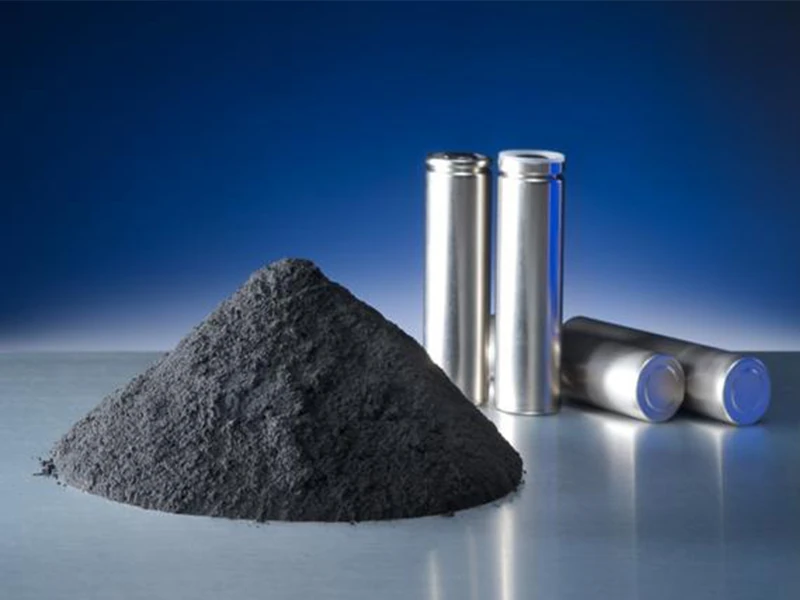
Silicon-carbon composites are nevertheless difficult materials to process. During charge and discharge, silicon can expand by 100–300%, compared with approximately 10% for graphite. This expansion and contraction can pulverize the anode material and severely shorten battery life. Silicon is also a semiconductor with much lower electrical conductivity than graphite, increasing irreversibility during lithium-ion insertion and extraction and lowering first-cycle Coulombic efficiency. This consumes excessive electrolyte and lithium inventory, further degrading cycle life. Silicon-carbon anode development and application therefore require substantial technical expertise.
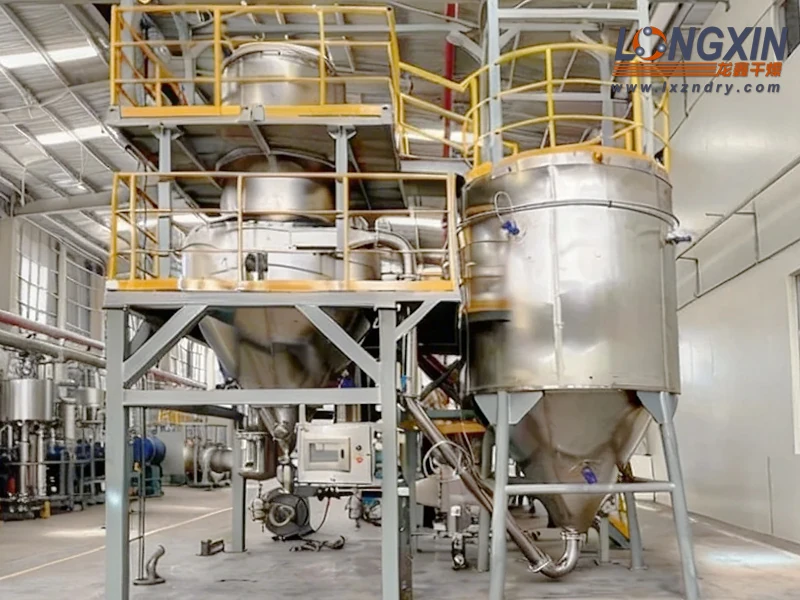
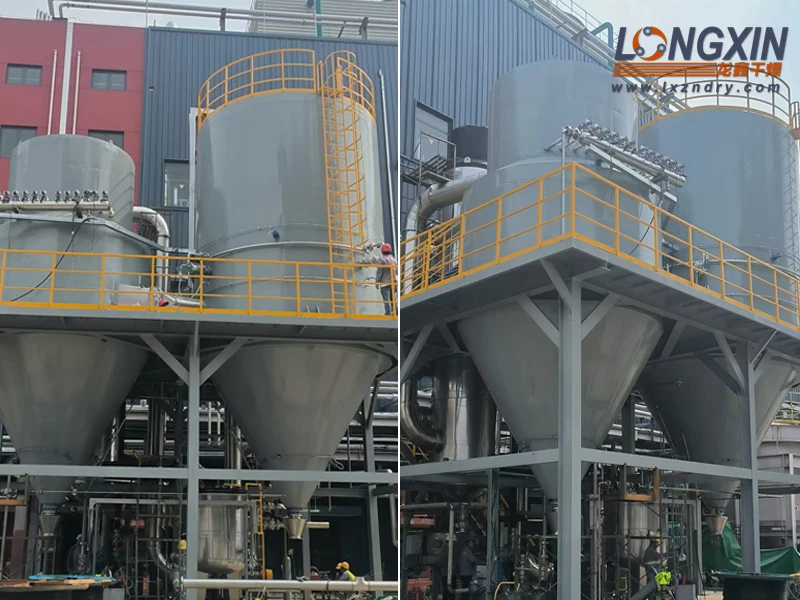
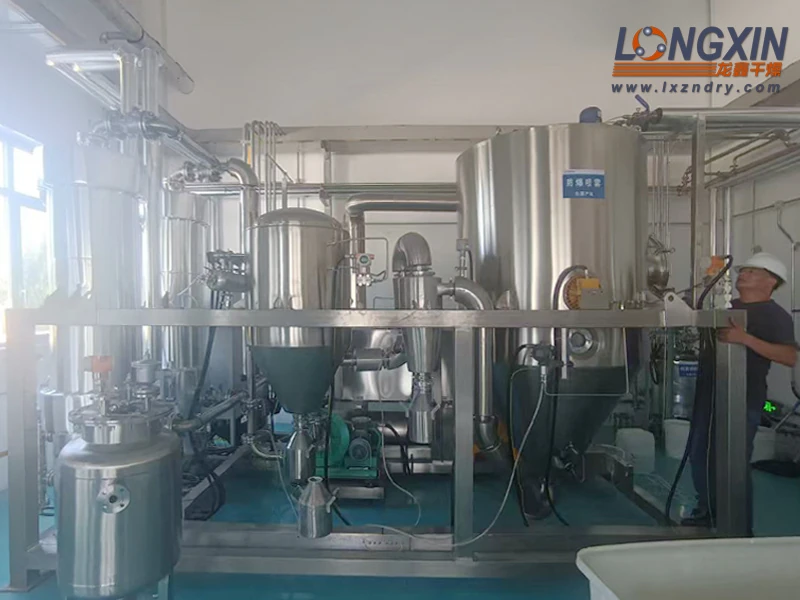
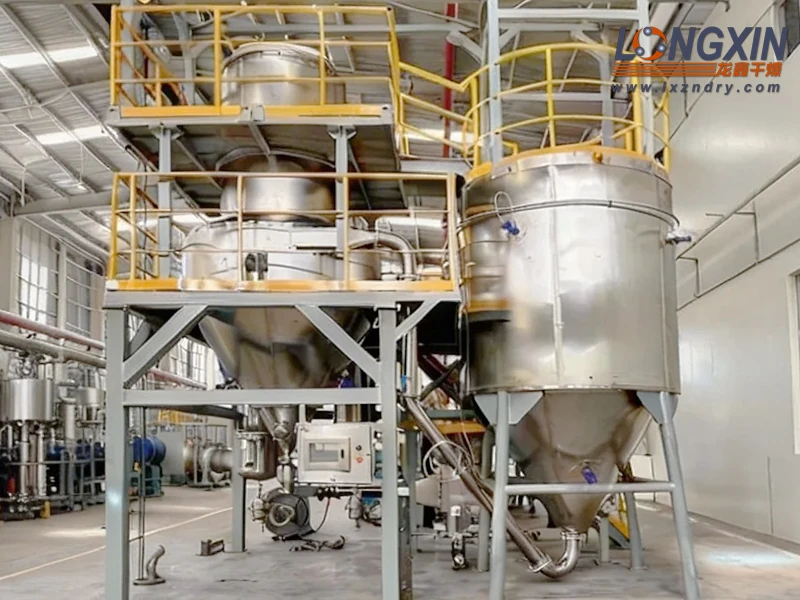
Commercializing silicon-carbon anodes also presents numerous challenges. Material performance must be further improved to achieve higher energy density and longer cycle life through optimized material structures and manufacturing processes. Drawing on years of experience in spray-drying tower development and manufacturing, as well as its expertise in closed-loop systems, Jiangsu Longxin Smart has combined explosion protection, safety, environmental protection and energy-saving technologies in a closed-loop spray dryer designed specifically for silicon-carbon composites. The system improves silicon-carbon manufacturing processes, reduces production costs, supports large-scale commercial production and helps advance the silicon-carbon anode industry toward high-volume manufacturing.
Princípio de funcionamento
The closed-loop spray dryer is well suited to drying silicon-carbon composites and other solvent-bearing materials while recovering organic solvents from the process. By integrating explosion protection, safety, energy efficiency and environmental performance, it creates a new production pathway for silicon-carbon composite materials.
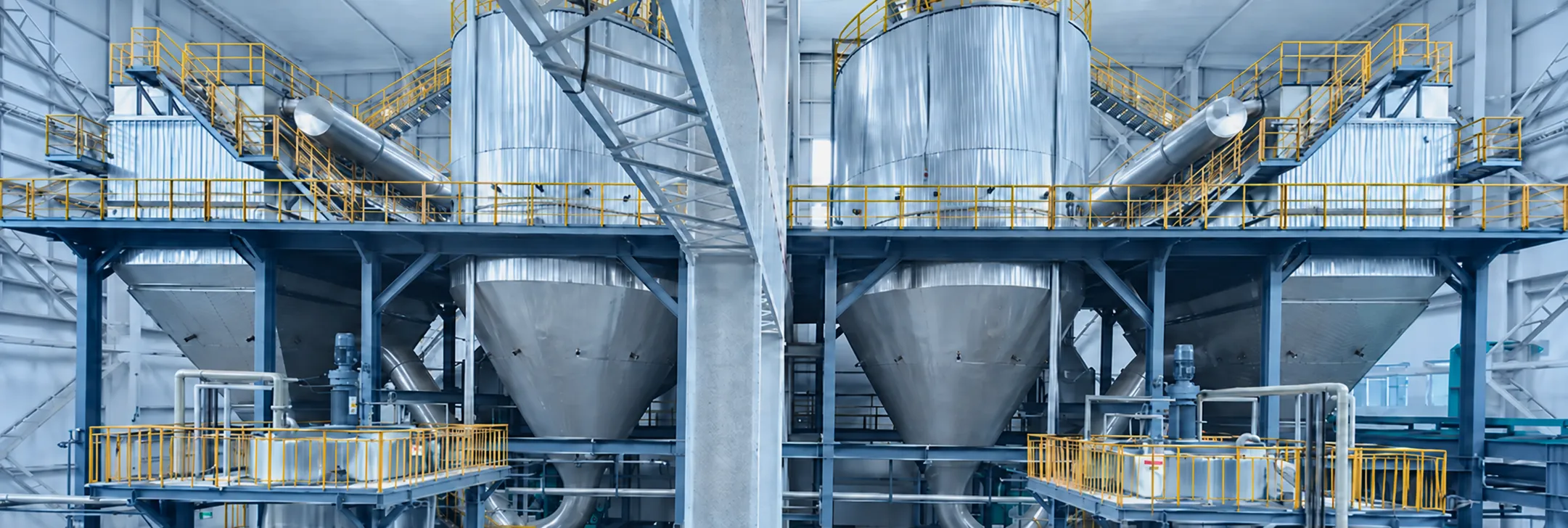
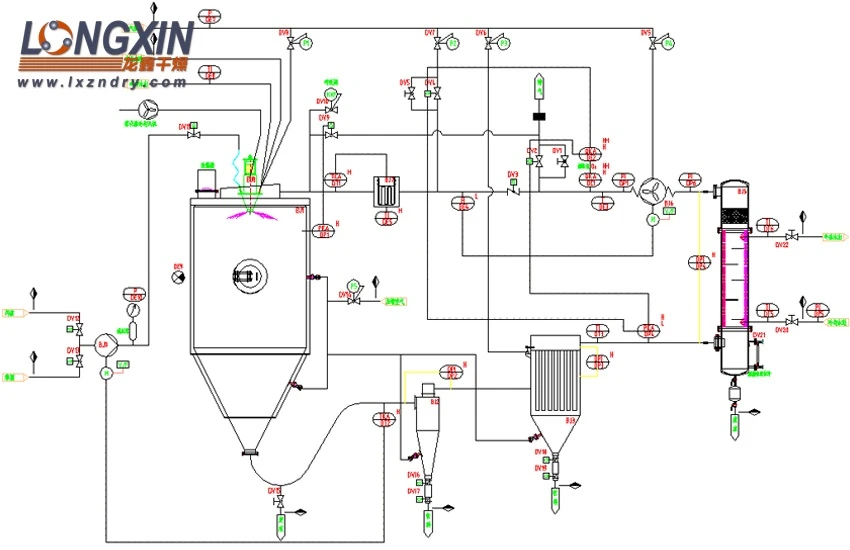
The explosion-proof closed-loop spray-drying system operates in a sealed environment using an inert drying medium, typically nitrogen. It is suitable for materials containing organic solvents, materials that release toxic gases, and materials prone to oxidation during drying. Nitrogen is heated and introduced into the drying chamber. The liquid feed is delivered by a screw pump to a centrifugal atomizer, where high-speed rotation breaks it into fine droplets. Heat and mass transfer take place inside the drying chamber, and the dried powder is discharged from the bottom.
Driven by a circulation fan, solvent vapor carrying entrained dust passes through a cyclone separator and scrubber for dust removal. The solvent-laden gas is then cooled in a condenser, where the organic solvent condenses into liquid and is discharged. The non-condensable inert gas is reheated and recirculated as the drying medium. By contrast, conventional centrifugal spray dryers continuously introduce and exhaust air to remove moisture. This closed-loop recirculation is a key difference between the explosion-proof closed-loop centrifugal spray dryer and conventional spray dryers.
Melhorias técnicas
1. Closed-Loop Drying for Silicon-Carbon Composites
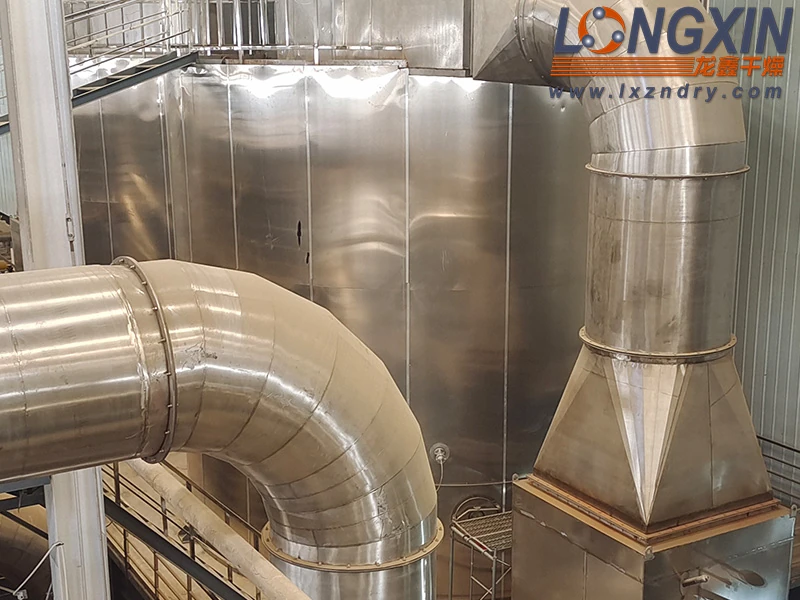
Each pipeline connection in the closed system uses a specialized sealing structure designed to remain leak-free at pressures of up to 0.5 MPa, providing excellent containment and high thermal efficiency. Nitrogen is used as the inert drying medium to prevent toxicity, oxidation and explosion hazards. After absorbing and releasing solvent vapor, the gas can be recirculated through the system.
2. Pulse-Jet Bag Filtration and Multi-Stage Condensation for Solvent Recovery
The closed-loop centrifugal spray-drying system combines closed-loop operation with pulse-jet bag filtration and solvent-recovery technology. This improves recovery of silicon-carbon composite products while reducing energy consumption and environmental impact.
The system includes condensation and recovery equipment for the solvent in the feed, enabling the recovered solvent to be reused after secondary treatment. Drying and solvent removal are completed under hot conditions in a sealed nitrogen atmosphere, and the solvent is recovered through condensers, improving overall process safety. The fully enclosed design also supports high material recovery. This level of material recovery is difficult to achieve with many conventional dryer designs.
3. Automatic Pressure-Differential Control and Explosion Relief
The closed-loop spray dryer uses positive-pressure inert-gas circulation and automatic pressure-differential control, a technology that is uncommon in conventional spray-drying systems. The centrifugal spray dryer operates at a working pressure of no more than 0.1 MPa, providing near-atmospheric operating conditions. This gives the vessel and piping a high safety margin, while positive pressure enables more effective control of nitrogen and other inert gases.
Automatic pressure control works as follows: when nitrogen pressure in the drying system falls below the set operating pressure, the nitrogen supply valve opens automatically; when the set pressure is reached, the valve closes automatically. This improves operational safety. The drying chamber is also equipped with explosion-relief devices such as rupture discs. If system pressure reaches the upper safety limit, the rupture disc opens automatically to release pressure.
When static electricity generated by particle friction or gas expansion increases system pressure, these controls help reduce the risk of overpressure or explosion and further improve equipment and process safety.
4. Inline Oxygen Monitoring
The closed-loop spray dryer uses inline oxygen monitoring during silicon-carbon composite production, a capability uncommon in conventional spray-drying systems. It serves two main purposes: first, to detect leaks caused by equipment faults and further improve operational safety; and second, to prevent oxygen ingress from reducing nitrogen purity and oxidizing the product, thereby maintaining product quality.
The inline oxygen monitoring system can be set with a permissible residual-oxygen range. If oxygen concentration exceeds the set limit, the system emits an audible and visual alarm and automatically cuts off power, indicating a possible leak and prompting prompt corrective action.
5. Intelligent Control System
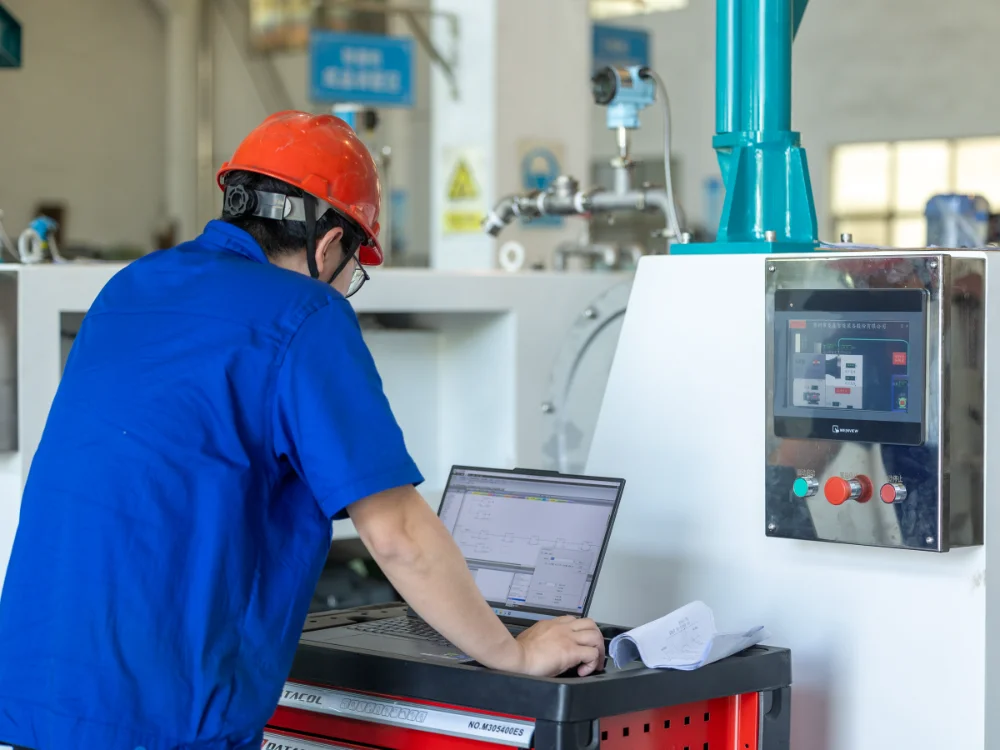
The silicon-carbon composite closed-loop spray dryer uses a PLC and touchscreen human-machine interface. Process-flow diagrams are displayed dynamically. Product particle size, bulk density and moisture content can be adjusted within the target ranges by changing operating conditions, making process control straightforward. The system also includes inline pressure monitoring, inline oxygen-concentration monitoring and clean-in-place (CIP) equipment.