Precise Temperature Control + Uniform Air Distribution: The “Longxin Code” for Elevating Yeast Powder Quality
In the yeast and yeast-derivative industry, drying is evolving from a conventional post-processing step into a critical control point that affects product activity, solubility, particle-size distribution, moisture stability, and production economics. Although products such as active dry yeast, yeast extract, yeast protein, yeast for animal nutrition, and yeast for feed additives differ in material form, solids content, heat sensitivity, and end use, the challenges shared by R&D and production teams are becoming increasingly clear: uneven drying, wall deposition, fluctuating product yield, high final moisture, batch-to-batch quality variation, and dust and odor emissions all directly affect product competitiveness and production efficiency.
To address these common challenges, Longxin Drying has combined its purpose-built low-temperature centrifugal spray dryer for yeast powder with its drum scraper dryer as a “dual-engine” approach. By integrating precise temperature control, uniform air distribution, system interlocks, and digital management into the engineering design, Longxin provides the fermentation industry with complete drying solutions that are more closely aligned with specific material characteristics.
Directly Addressing the Challenges: Balancing Yeast Quality and Drying Efficiency
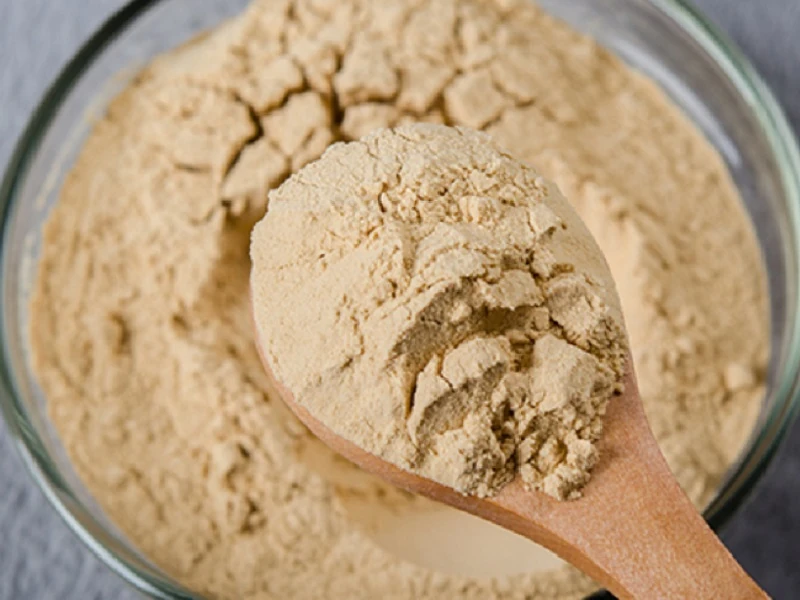
Applications in baijiu, beer, and soy sauce production, as well as yeast deep-processing, place different priorities on the moisture content, activity, color, odor, solubility, and microbiological indicators of yeast powder.
- Yeast extract generally has a solids content of approximately 20–32%, with a final moisture requirement below 4%;
- Active dry yeast must balance activity retention with rehydration performance;
- Yeast protein and yeast for animal nutrition require greater attention to protein functionality, hygiene indicators, and processing stability.
During drying, inlet-air temperature, outlet-air temperature, atomized droplet size, material residence time, airflow distribution inside the tower, and wall-deposition conditions are closely coupled. Fluctuation in any one of these parameters can lead to uneven moisture, localized overheating, deterioration of wall-deposited material, or reduced yield.
In conventional production practice, raising the inlet-air temperature is often used to increase evaporation capacity. However, excessive temperatures or uneven airflow increase the thermal exposure risk for heat-sensitive materials. Lowering the temperature may instead result in higher final moisture, increased wall deposition, and reduced capacity. The trade-off between quality and efficiency has therefore become a practical challenge for fermentation companies seeking to expand production and upgrade their products. Customers need more than an accumulation of individual equipment parameters; they need a system solution that coordinates material properties, process windows, energy structure, cleaning and maintenance, and safety interlocks.
In yeast-powder drying projects, Longxin Drying focuses its design on temperature closed-loop control, airflow organization, atomization matching, and dust recovery. The objective is to improve operating efficiency while maintaining consistent quality and to reduce batch-to-batch variation at a controllable cost.
Building on the “Xin” Advantage: Turning Advanced Drying Technology into New Quality Productive Forces for Fermentation
Different yeast materials require different drying paths.
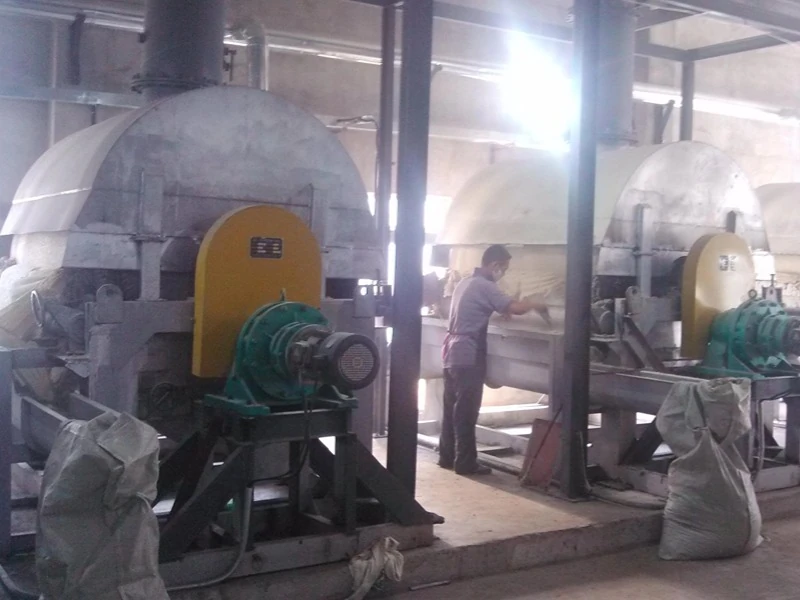
(1) Feed-Grade Yeast Powder: Drum Scraper Dryer
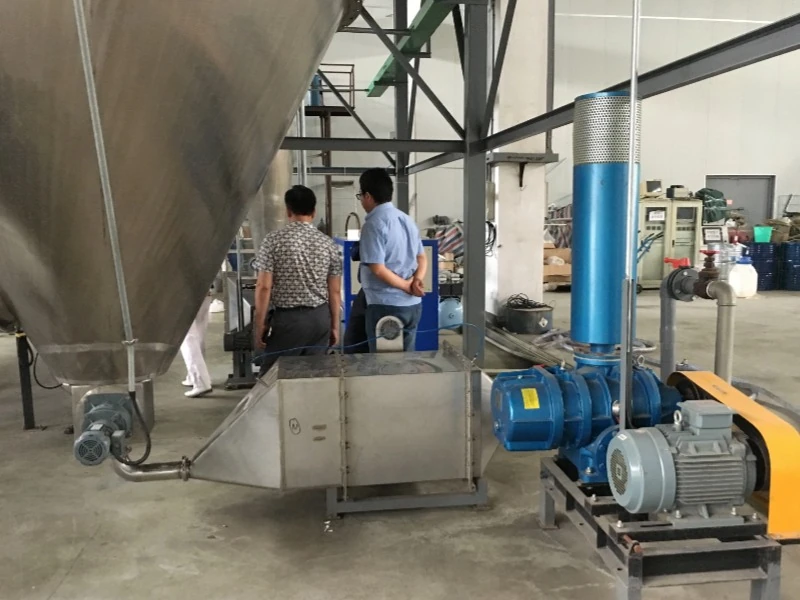
For feed-grade yeast powder and certain low-sugar yeast materials, the drum scraper dryer uses indirect conduction heating as its basic drying method. A material distributor applies the feed evenly to the drum surface to form a thin film. Moisture evaporates as the drum rotates, and a scraper removes the dried product, which falls into a screw conveyor for continuous discharge.
The drying system for low-sugar yeast production combines a material distributor, drum, scraper, screw conveyor, filter screen, and air filter to control the degree of drying and moisture content, reduce yeast powder entrainment through the exhaust outlet, and lower odor volatilization. This approach is highly compatible with the material form and the requirements of continuous production, making it suitable for feed-grade yeast powder and other applications that require moisture stability and odor management.
(2) Food-Grade Yeast Powder: Low-Temperature Centrifugal Spray Dryer
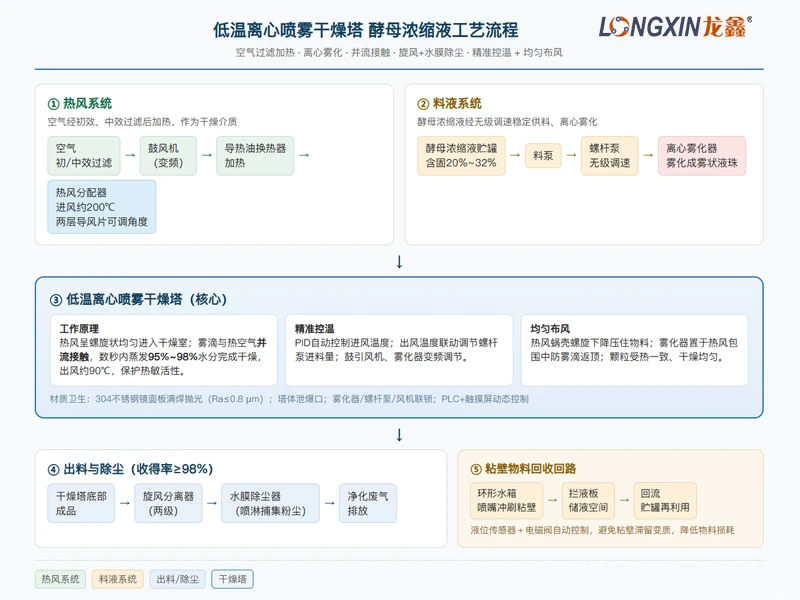
For high-value powders such as food-grade yeast powder, yeast extract, and yeast protein, the low-temperature centrifugal spray dryer emphasizes atomization, co-current airflow, and rapid drying.
According to the technical specification for the LPG1000 yeast extract project, the system is designed with a water-evaporation capacity of 1,000 kg H₂O/h, a solids content of 20–32%, and a final moisture content below 4%. The inlet-air temperature is 160–200°C and the outlet-air temperature is 90°C. The system uses an open-cycle configuration, variable-frequency centrifugal atomization, co-current contact, a steplessly adjustable screw-pump feed, a thermal-oil heat exchanger for heating, and two-stage cyclone separation followed by a water-film scrubber for dust removal. Product recovery is high, product-contact parts are made of 304 stainless steel, and the control system uses a PLC with a touchscreen. The blower, induced-draft fan, and feed system are VFD-interlocked. These parameters are not isolated equipment specifications; they represent system boundaries determined jointly by material properties, evaporation load, heat-source conditions, and product-collection method.
In this context, “low-temperature” does not mean simply reducing the inlet-air temperature to a level comparable with freeze drying. Instead, co-current hot-air organization, atomized droplet-size control, and residence-time matching keep the droplets at moderate temperatures as they cool through evaporation, preventing particles from remaining in a high-temperature environment for extended periods. For heat-sensitive yeast extract and yeast protein, this process strategy—rapid evaporation, short-duration drying, and stable outlet temperature—helps balance moisture control with functional-product quality.
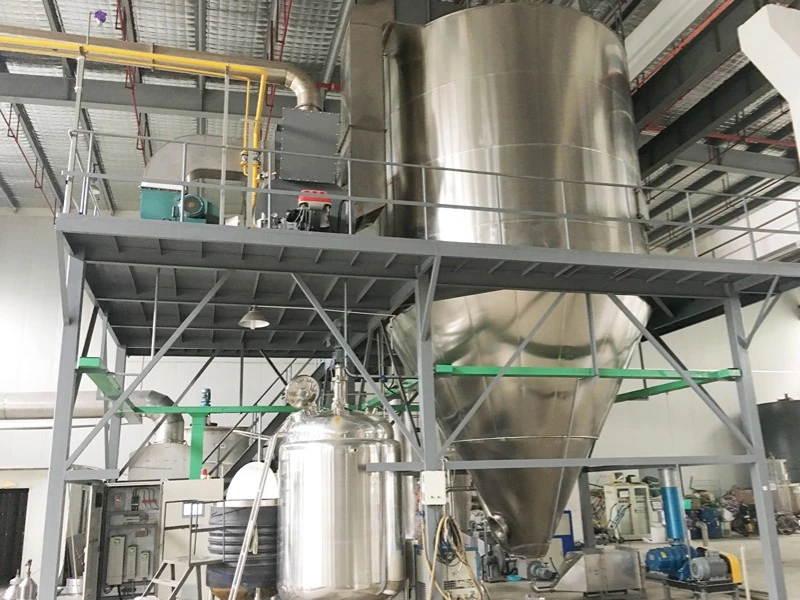
Intelligent Manufacturing in Practice: A Dual-Engine Approach to Upgrading Yeast Powder Spray-Drying Quality
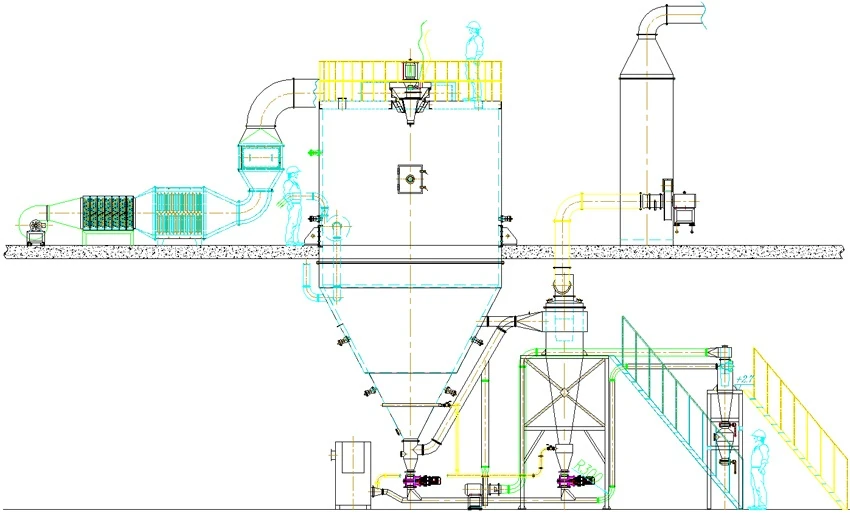
The working principle of the purpose-built low-temperature centrifugal spray dryer for yeast powder is straightforward:
- Filtered and heated air enters the air distributor at the top of the drying tower and is introduced uniformly into the drying chamber in a spiral flow;
- The feed is delivered by a screw pump to a high-speed centrifugal atomizer and dispersed into fine droplets;
- The droplets contact the hot air in a co-current flow and complete most of the moisture evaporation within seconds, forming powder particles;
- The finished product is discharged from the bottom of the drying tower and from the cyclone separator, while exhaust gas passes through cyclone separation and water-film scrubbing before being discharged by the fan.
The real measure of engineering capability lies in the detailed design surrounding precise temperature control and uniform air distribution.
(1) Temperature Control
The system displays and closed-loop controls the inlet-air temperature, drying-tower temperature, and outlet-air temperature.
- The inlet-air temperature uses PID control to adjust heat supply automatically according to the setpoint;
- The outlet-air temperature is linked with the screw-pump feed rate, automatically tracking the feed rate to stabilize the outlet temperature;
- The thermal-oil heat exchanger, thermal-oil temperature, and pressure are displayed online, providing an observable operating window on the heat-source side;
- The atomizer is interlocked with a cooling-water flow switch so that it can only start when cooling water is flowing normally;
- The atomizer is interlocked with the screw pump so that feed can only start when the atomizer is running;
- The blower and induced-draft fan are interlocked to ensure the correct system start-up and shutdown sequence.
These interlocks convert operator experience into programmed constraints, reducing quality variation caused by incorrect operation.
(2) Air Distribution
The hot air entering the tower passes through an inlet volute, hot-air distributor, guide cone, guide vanes, and related components.
- The hot-air volute uses a spiral descending structure that helps direct and stabilize the material flow as the hot air enters the tower;
- The hot-air distributor is equipped with two layers of guide vanes with adjustable angles to control the tangential angle at which hot air enters the tower;
- The atomizer is positioned below the hot-air distributor and within the surrounding hot-air envelope. The distance between the atomizer disc and the tower roof is engineered to reduce droplet backflow toward the roof and wall deposition;
- For hygroscopic and wall-adhesive materials such as yeast extract, airflow organization and atomization matching are often more important than simply increasing air velocity.
(3) System Optimization
The drying tower can be equipped with a jacket cooling fan, pneumatic knockers, quick-access cleaning ports, inspection manholes, a vacuum test port, and an explosion vent.
- Pneumatic knockers use pulsed impacts to help release powder from the tower wall and cone section;
- The drying chamber is equipped with an explosion vent that opens when pressure exceeds the setpoint to help protect equipment and personnel;
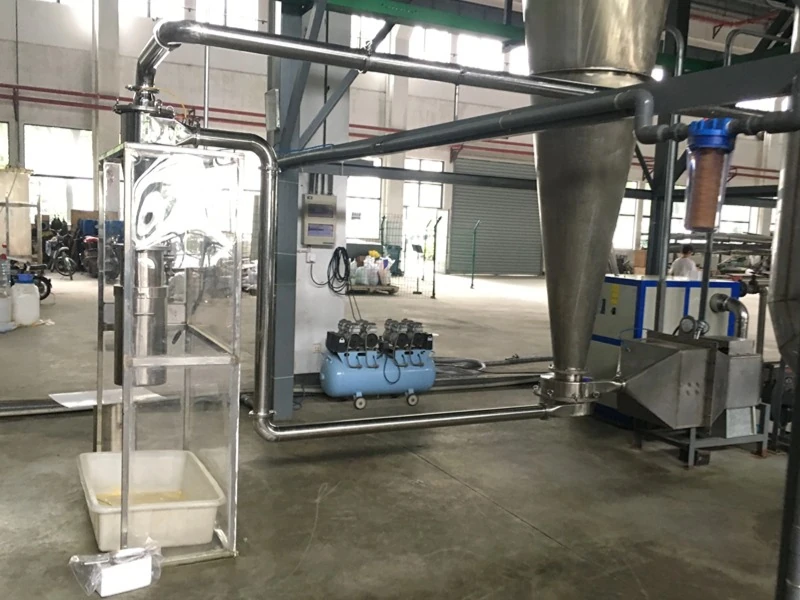
- The cyclone separator is equipped with a rotary airlock discharge valve, and the water-film scrubber is supplied with a circulation pump and piping;
- After cooling, the product enters a pneumatic conveying system for transfer to the silo. Optional equipment includes a chilled dehumidifier, centralized powder-collection cyclone, inline screener, and silo rotary airlock valve;
- For wall-deposition control, the yeast concentrate drying tower uses an annular water tank, spray nozzles, a liquid-retaining baffle and reservoir volume, a level sensor, and flush-water reuse valves. Water from the water-film scrubber is used to wash wall-deposited material and return it to the storage tank. A vibrator, sight glass, and other auxiliary devices support observation and discharge.
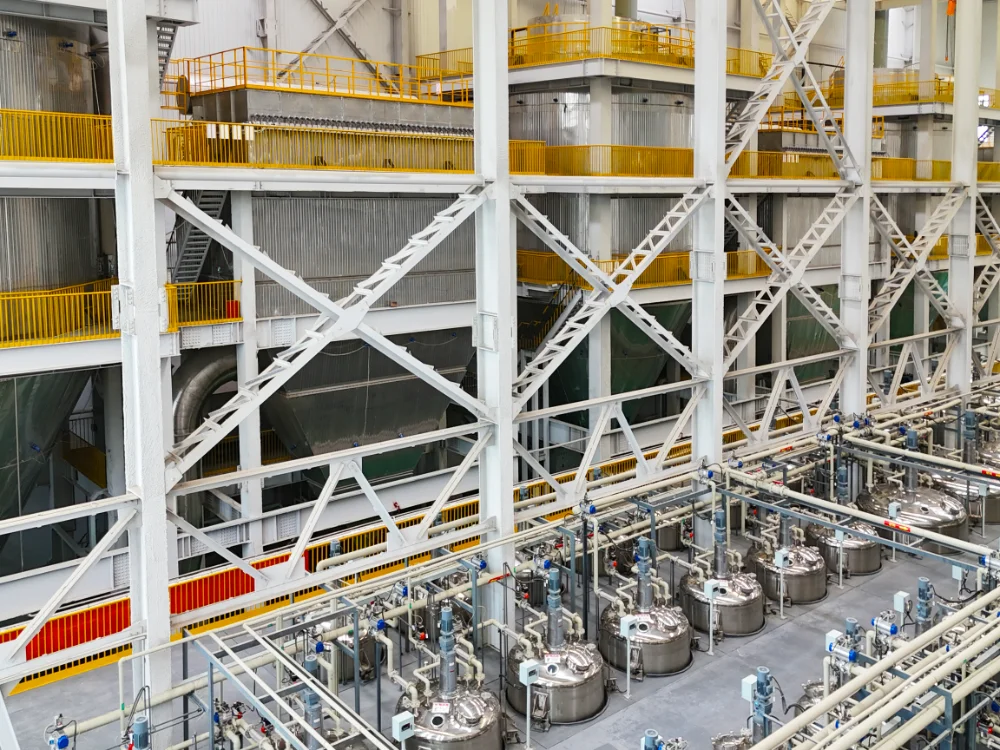
These technical improvements show that yeast drying quality cannot be improved through the tower alone. Atomization, airflow, wall deposition, dust removal, water reuse, and cleaning must be designed as an integrated system.
Deepening Industry Expertise: Advancing the Fermentation Industry Through Data and Green Technology
(1) Competition in the Fermentation Industry Is Shifting from Experience-Driven to Data-Driven
Parameters such as temperature, pressure, flow rate, differential pressure, current, liquid level, outlet-air temperature, and feed rate are no longer merely numbers on field instruments. They provide the basis for defining process windows, optimizing energy consumption, and planning maintenance.
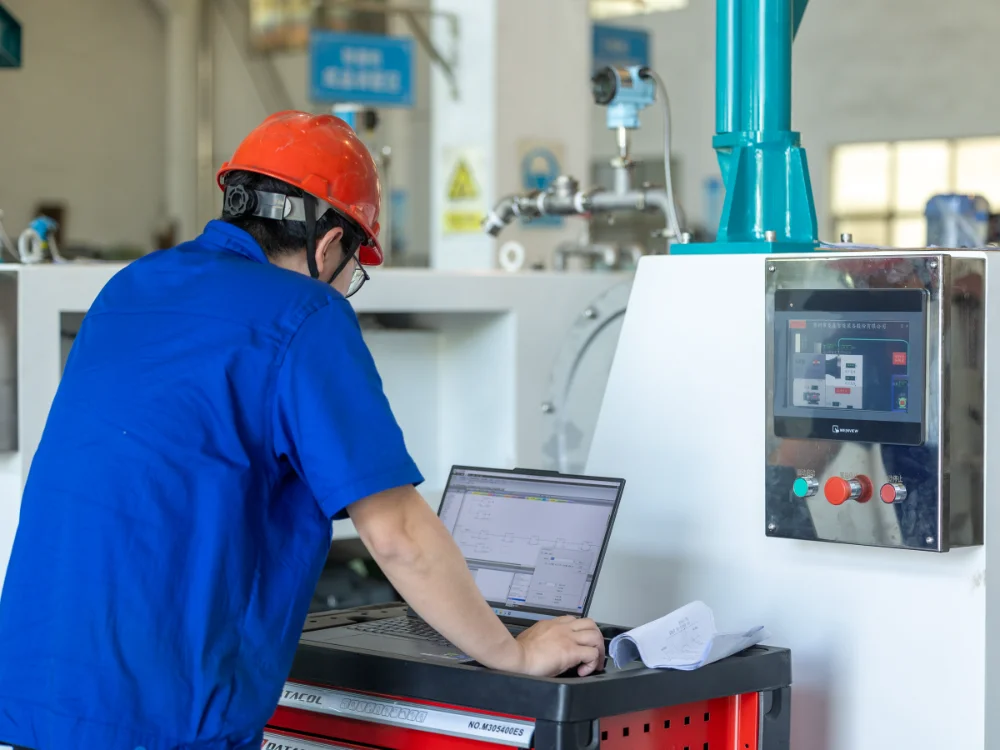
In its yeast-powder drying systems, Longxin Drying uses a PLC and touchscreen to support parameter setting, dynamic display, alarm interlocks, and historical data management. This enables R&D personnel to correlate material properties with drying curves and production personnel to organize batch production using repeatable parameters. For products such as active dry yeast, yeast extract, yeast protein, yeast for animal nutrition, and yeast for feed additives, this data capability helps shorten process scale-up cycles and reduce trial-and-error costs.
(2) Green Transformation Is Also Reflected in Practical Details
- Two-stage cyclone separation combined with a water-film scrubber, rotary airlock discharge, and centralized powder collection helps reduce dust emissions and material losses;
- Circulation of water-film scrubber water and recovery of wall-deposited material help reduce waste;
- VFD-controlled blowers and induced-draft fans, thermal-oil heat exchange, and outlet-temperature-linked feed control help adjust operation according to load;
- Pneumatic conveying and chilled dehumidification support product cooling, transfer, and moisture-absorption control.
Using innovation to protect health and fermentation to empower life ultimately comes down to consistent moisture in every batch, effective use of every unit of heat, and convenience in every cleaning and maintenance operation.
In the future, Longxin Drying will continue to deepen its expertise in brewing and fermentation. For materials such as yeast and yeast derivatives, active dry yeast, yeast extract, yeast protein, yeast for animal nutrition, and yeast for feed additives, the company will provide customized, high-efficiency, low-energy complete drying solutions to help customers overcome quality bottlenecks, improve production efficiency, and strengthen core competitiveness. High-quality development in the fermentation industry requires equipment manufacturers and R&D teams to work together to translate process language into engineering language. With its “Longxin Code” of precise temperature control, uniform air distribution, and system integration, Longxin Drying looks forward to working with partners to open a new chapter in the high-quality development of the fermentation industry.