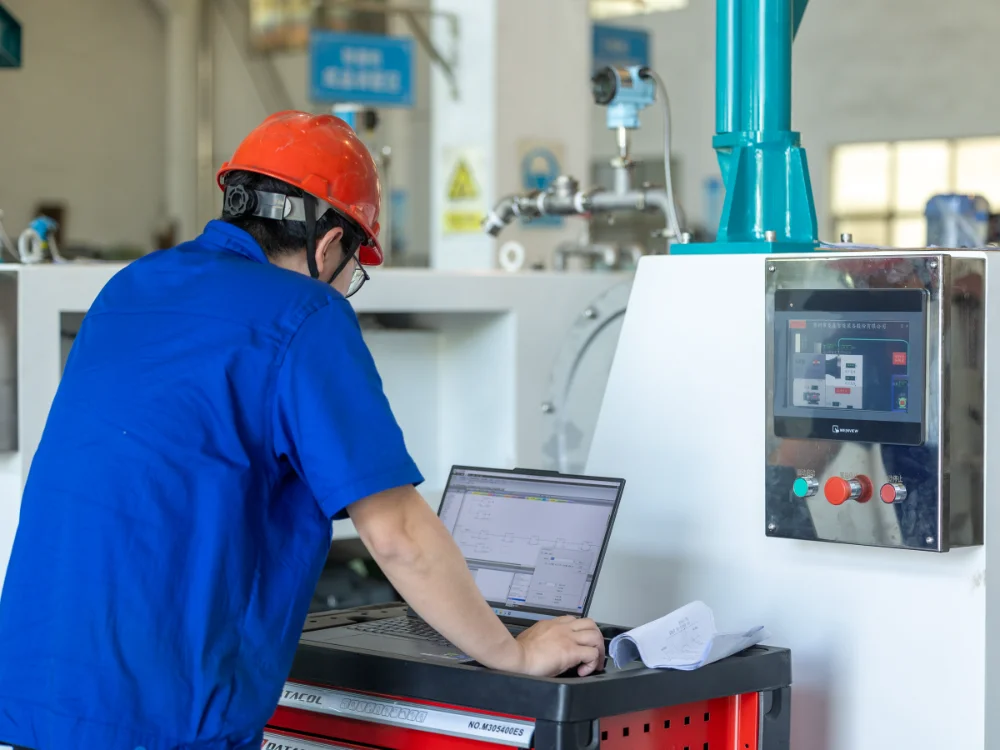
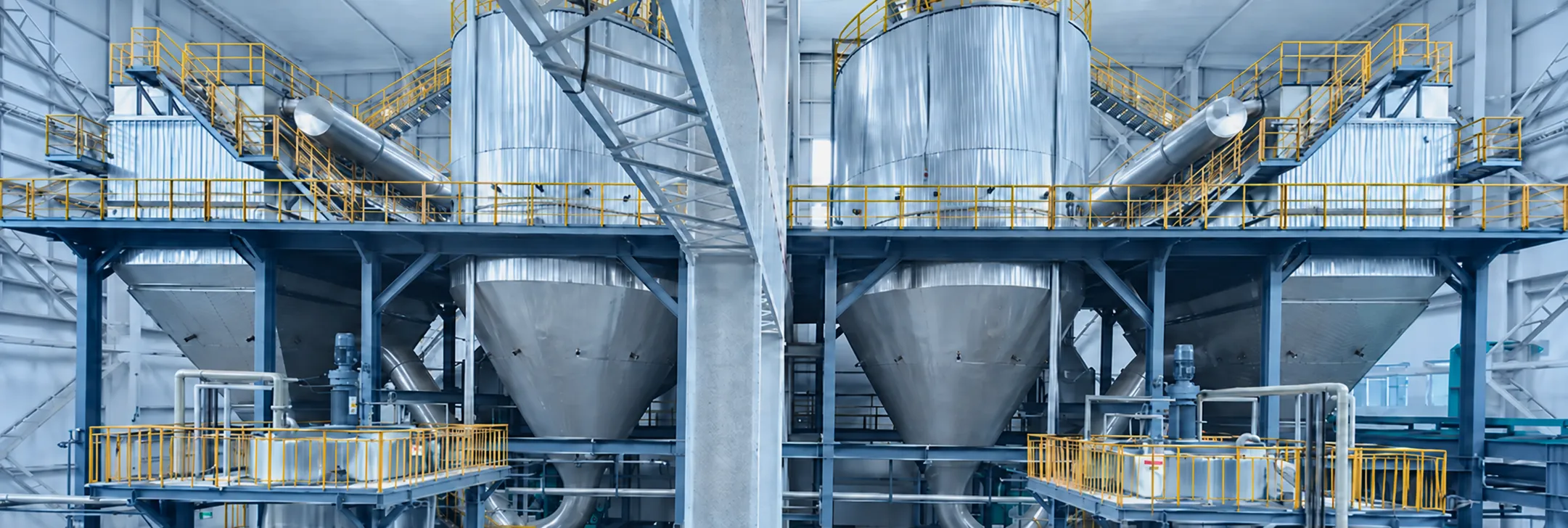
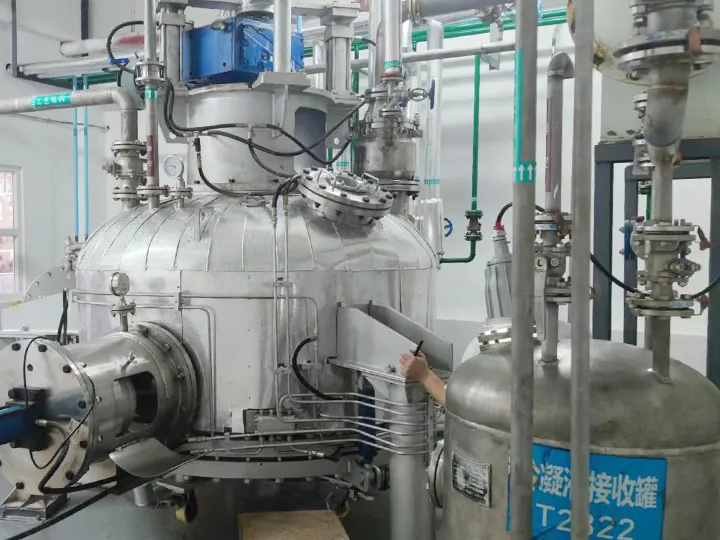
In the downstream processing steps of pharmaceutical, pesticide, explosive, dyestuff, pigment and other fine chemical production, unit operations such as filtration, washing and drying are routinely required. Conventionally these operations are performed in separate items of equipment — centrifugal filters, washing tanks, dryers and so on — with material transferred between them by piping or other means. Linking many separate units into one large system produces a long flow, low efficiency and a process that is difficult to regulate. With suspensions of high solids content, solids frequently adhere to the walls and block the piping, making normal production difficult. Open processing makes blockages easier to clear, but it cannot meet the regulatory requirements for pharmaceuticals, food and biological products, and it introduces safety risks when flammable, explosive, toxic or highly toxic materials are involved.
To overcome these shortcomings and to meet the chemical industry’s shift towards high quality, high added value, multiple product types and small batches, Longxin carried out extensive design and development work and succeeded in developing a multifunctional filter washing drying machine that integrates filtration, washing and drying. The result is a substantial improvement in equipment performance, with both structural design and application closely aligned to the relevant pharmaceutical regulations. The machine performs the three main functions of filtration, washing and drying, and can also carry out reaction, extraction, crystallisation, concentration, evaporation, mixing and crushing. It is a high-technology item of equipment offering the following advantages:
- Enclosed operation. Several process steps are completed within the same unit, reducing the influence of dust and micro-organisms on product quality and minimising losses of valuable material, thereby improving both product quality and yield.
- Fewer material transfer steps, particularly for filter cake, shortening the production cycle and increasing production capacity.
- Filtration and washing can be carried out under vacuum or under pressure, giving flexible, easily controlled operation.
- Safe handling of flammable, explosive, toxic or highly toxic hazardous materials, with reduced environmental pollution, better working conditions and safer operation.
- A short process flow, fewer equipment items, less plant space and lower engineering investment.
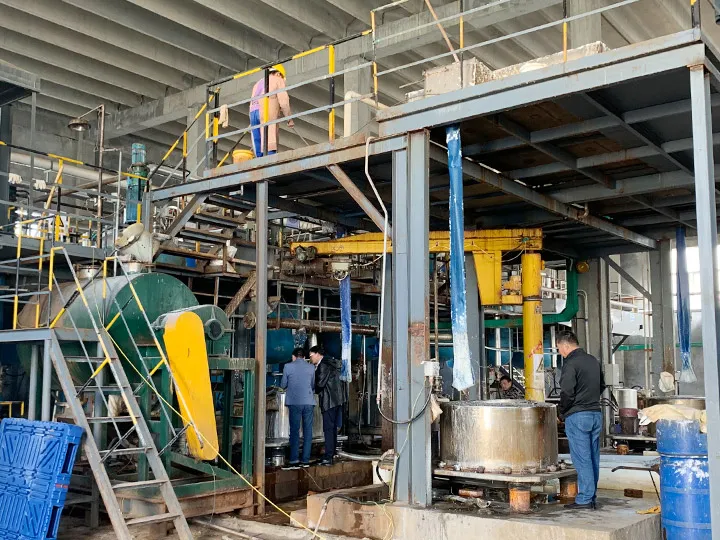
Flat-Plate Filter Washing Drying Machine — Structure and Principle
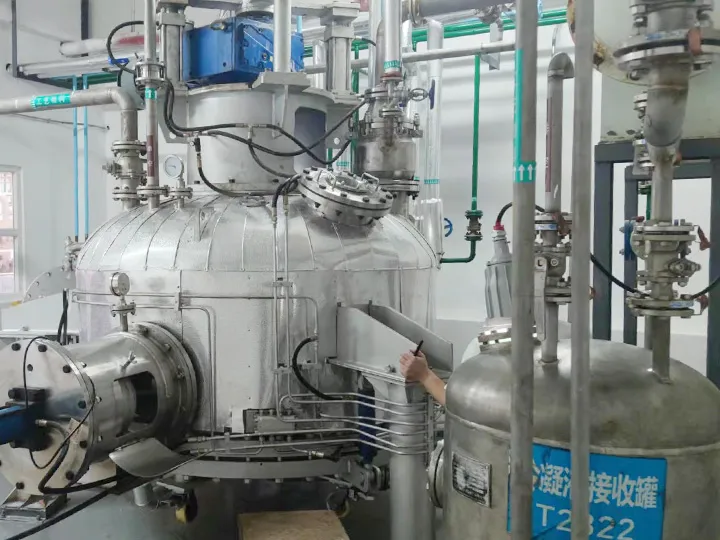
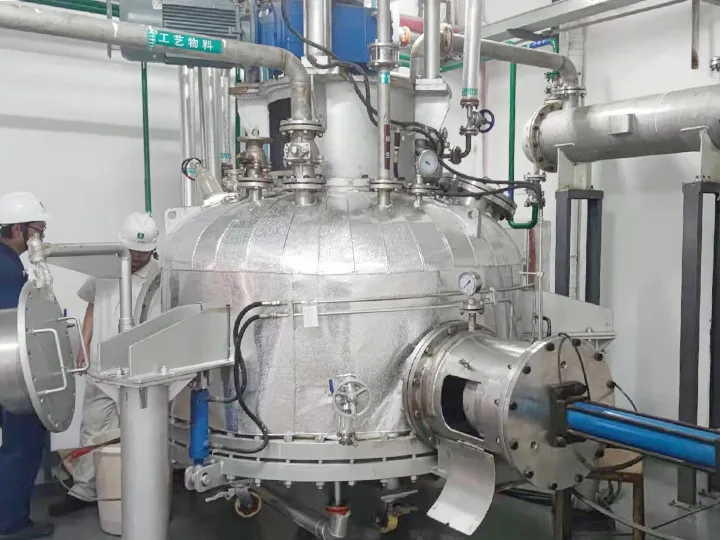
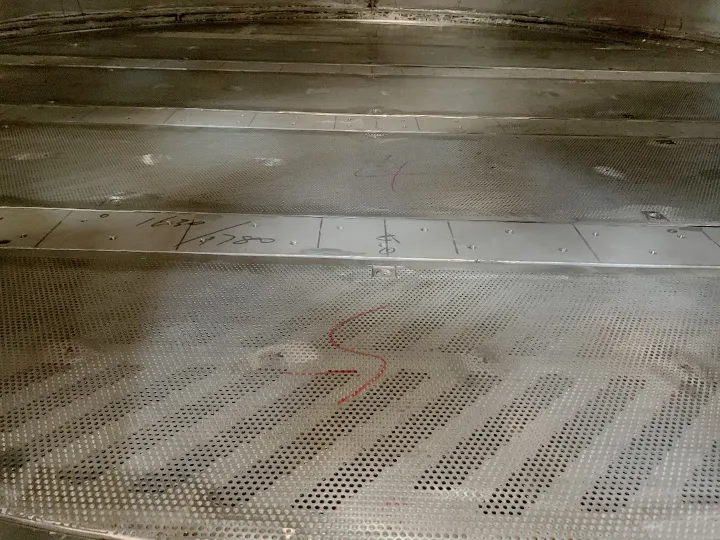
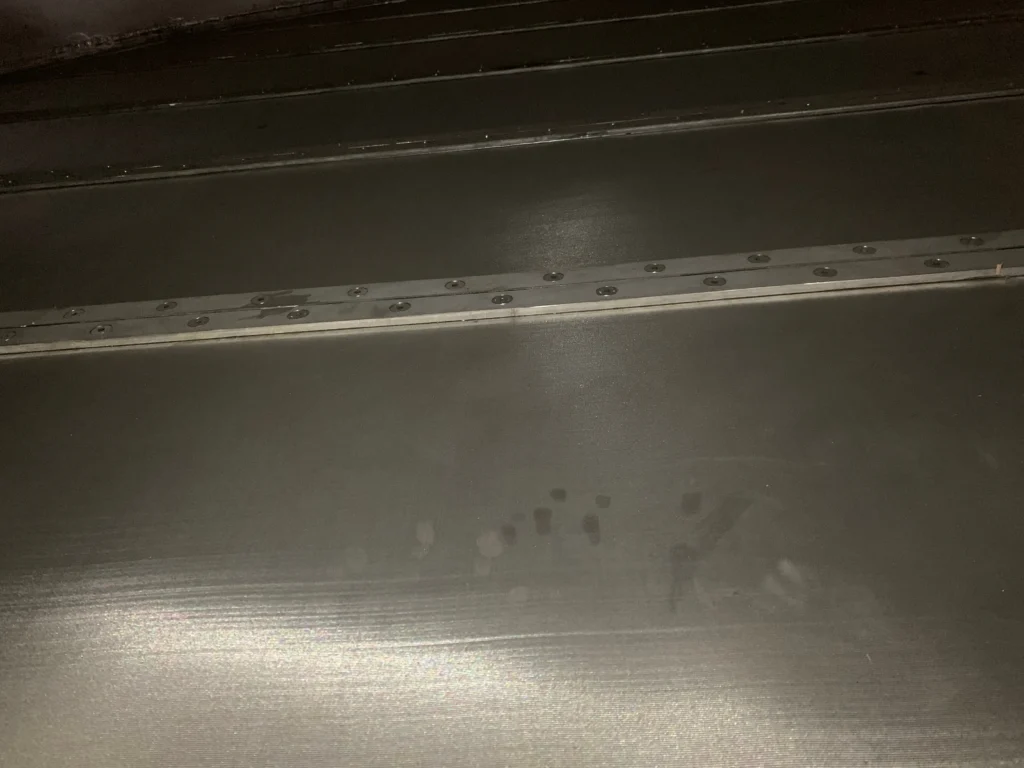
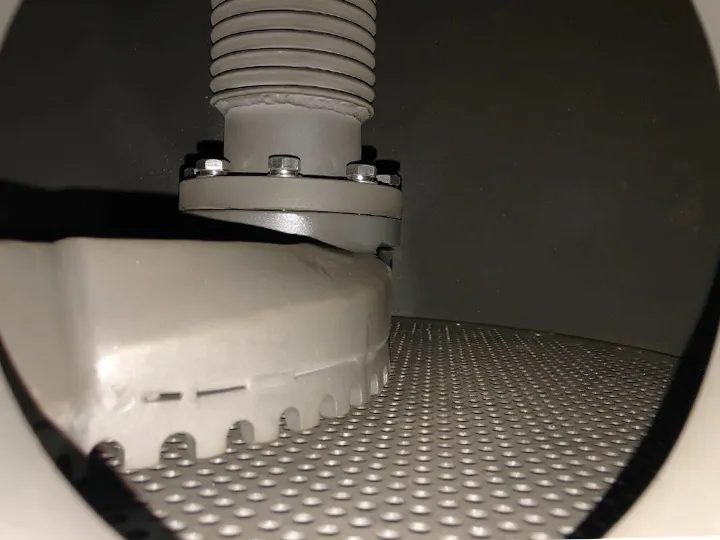
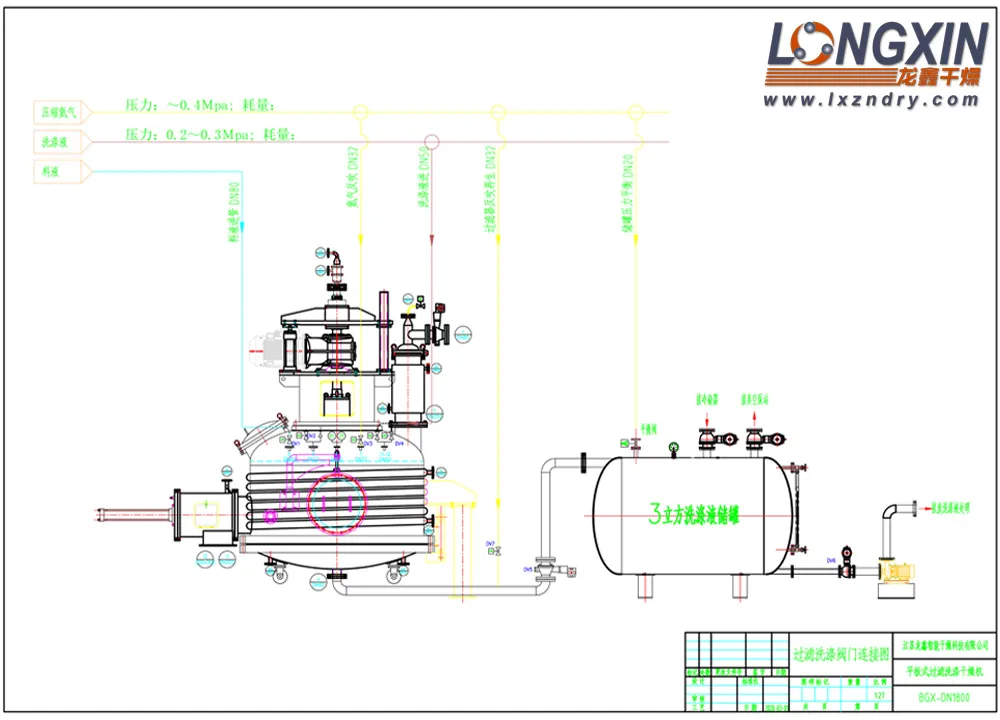
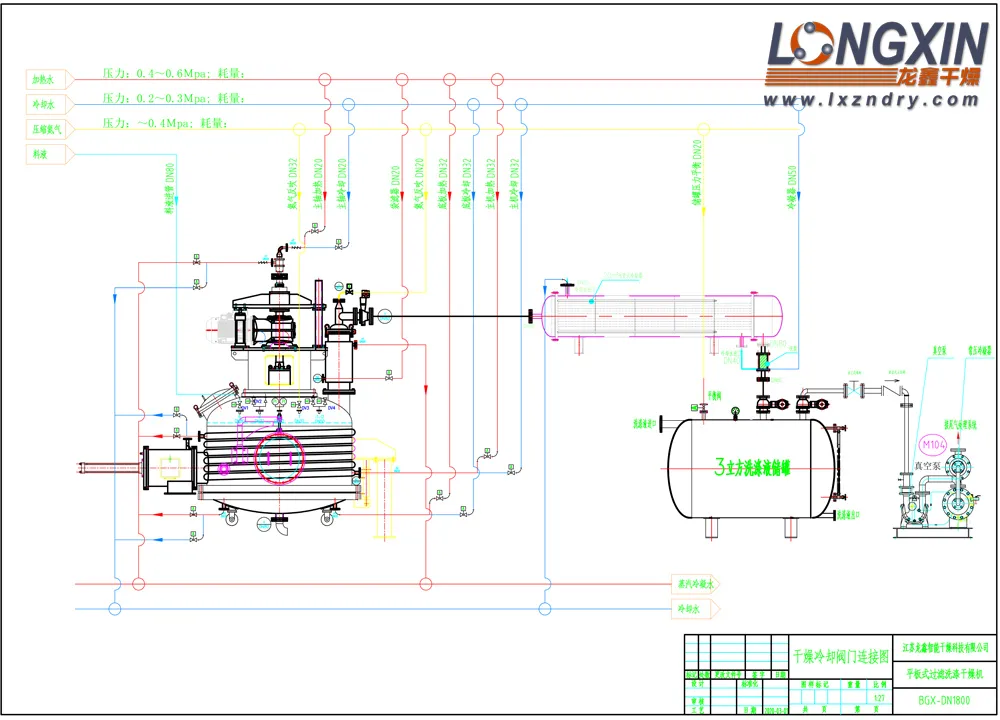
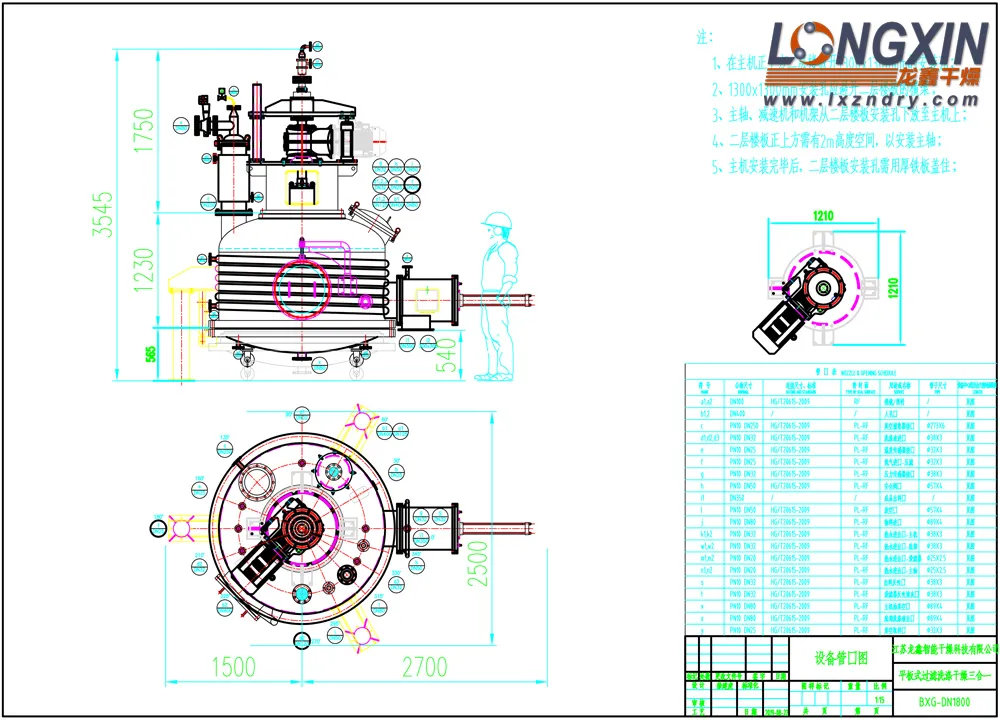
The filter washing drying machine, known in the industry as the “three-in-one”, can carry out filtration, washing, drying, sterilisation and discharge as a continuous sequence of process steps, although it operates in batch (intermittent) mode. It is widely used in pharmaceuticals, food, pesticides and chemicals. The machine consists mainly of a pressure-rated vertical vessel, a heating system, an agitation system (agitator shaft, impeller, mechanical seal and so on), an agitator lifting mechanism, a drive, the filter medium, a discharge valve, a spray system, a sterilisation system, a hydraulic power unit and the main control cabinet (including variable-frequency drives and PLC). Mechanical, electrical and instrumentation functions are integrated into one system.
Once the basic operations for a batch — filtration, washing, drying and solids discharge — have been completed, the machine can also dissolve material requiring further processing with a solvent and continue directly into the next process step.
Flat-Plate Filter Washing Drying Machine — Process Flow
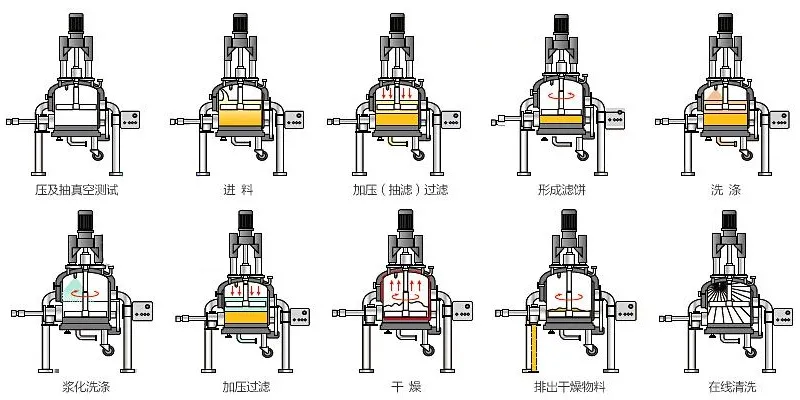
(1) Filtration
The solid-liquid mixture (crystal slurry) from the upstream reactor or crystalliser is discharged into the vessel of the three-in-one machine, where filtration separation is driven by a pressure differential. In practice, pressure filtration, vacuum filtration and combined pressure-vacuum filtration are all used. Pressure filtration employs clean compressed air, nitrogen or another inert gas, selected according to the properties of the solid-liquid mixture. If, for example, the mixture is easily oxidised or contains explosive media, compressed air cannot be used and an inert gas must be selected instead. Experience shows that in the pharmaceutical industry a filtration pressure of 0.2–0.3 MPa is generally sufficient, while some chemical or food products require higher filtration pressures of up to 1.0 MPa.
(2) Washing
After filtration, washing follows as the next process step. The vessel is fitted with a purpose-designed spray system that distributes the washing liquid evenly throughout the vessel. By operating the agitation system, the lifting mechanism and the drive, the impeller can both rotate and move axially up and down, so the material is thoroughly washed and impurities adhering to the crystal surfaces are removed. The washing liquid and the number of washes are determined by the material and the characteristics of the process.
(3) Drying
Drying in the three-in-one machine can be carried out by hot-air drying or by vacuum drying. In either case clean inert gas must be used, because dust is generated during drying and the equipment’s operating environment must be designed for explosion protection. Vacuum drying is currently the mainstream drying method for three-in-one machines. The main factors affecting the vacuum drying process are the degree of vacuum, the drying time and the characteristics of the impeller.
In vacuum drying, the vacuum system evacuates the inert gas from the vessel, reducing the number of gas molecules and isolating the material from air. It is particularly suitable for materials prone to oxidative degradation, for materials whose evaporated solvent must be recovered, and for heat-sensitive materials. Under vacuum, the risk of microbial contamination is reduced, or the growth of certain bacteria is inhibited, making the process particularly suitable for drying sterile materials.
Flat-Plate Filter Washing Drying Machine — Performance Features
In recent years, the chemical-grade filter washing drying machine has been rapidly promoted and adopted because it can complete filtration, washing, drying, sampling, automatic discharge and cleaning within a single vessel. It is progressively replacing equipment used in conventional crystallisation and drying lines — centrifuges, vacuum filtration tanks, vacuum tray dryers and double cone rotary vacuum dryers — and has become the new-generation equipment for filtration and drying in fine chemical production.
(1) Multifunctional integration and continuous operation
The three-in-one machine completes agitation, filtration, washing and drying within one enclosed unit, thereby avoiding the introduction of foreign matter and microbial contamination during material transfer and fully safeguarding product quality.
(2) Simple structure and improved production environment
The entire process, from feeding through to the discharge of the dried product, takes place in a single unit, greatly reducing the total number of process equipment items required; one machine performs the work of several conventional filtration units. Because the whole operation is carried out in a sealed condition, no liquid, gas or dust is released into the cleanroom, so there are no contamination or health hazards.
(3) Simplified process, small footprint and lower capital cost
Filtration, washing and drying are completed in one system, so the available building space is used to the full; at a time when floor space is at a premium, the volume of cleanroom required is greatly reduced, capital costs are low and substantial investment is saved. The process is better suited to large-scale production: it shortens the flow, reduces the number of equipment items, reduces plant space and lowers engineering investment, while improving product quality and reducing labour intensity, with good economic and social benefits.
(4) Fully enclosed production and solvent recovery
The three-in-one filter washing drying unit is a fully enclosed system. Operating in a closed system prevents toxic substances from polluting the air and reduces the risk of operator poisoning. The dried product can be conveyed mechanically to weighing and packing stations. Material and solvent are recovered almost completely, avoiding the waste caused by material loss and solvent evaporation.
(5) Clean production and thorough cleaning
The three-in-one unit is equipped with a dust collector that captures the dust generated during drying, meeting the requirements of clean production. The system provides automatic spraying and agitation, so the filter cake can be washed thoroughly, reducing wastewater discharge and the cost of wastewater treatment.