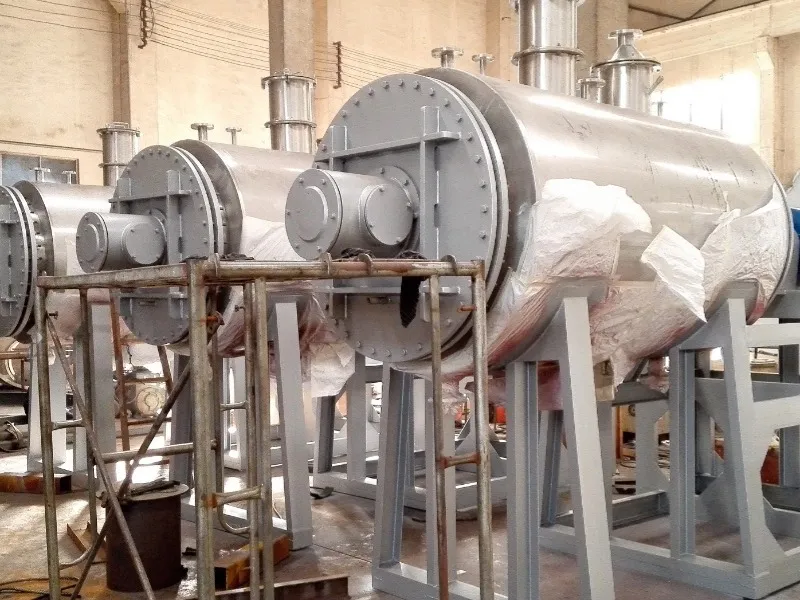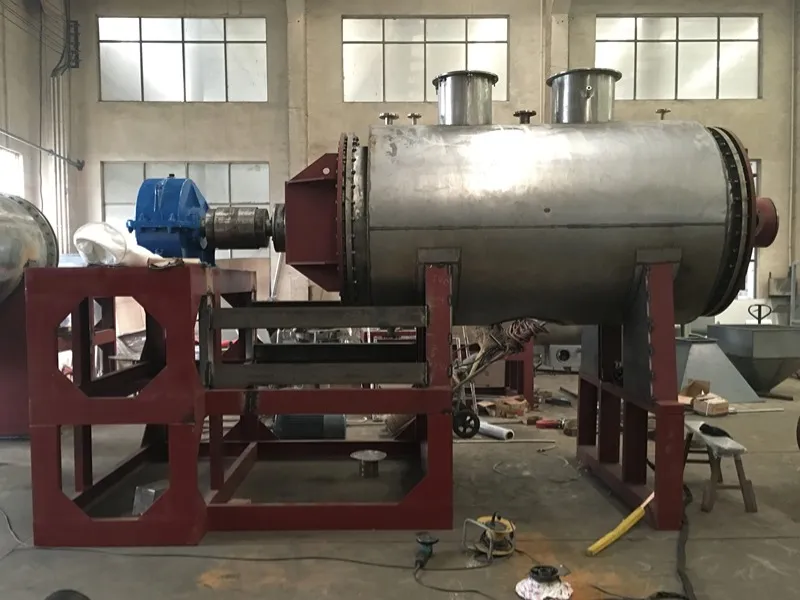
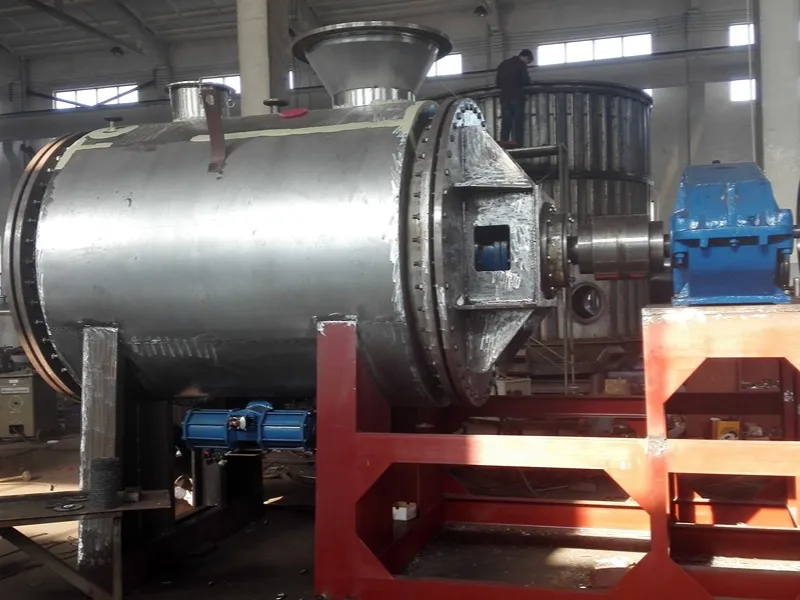
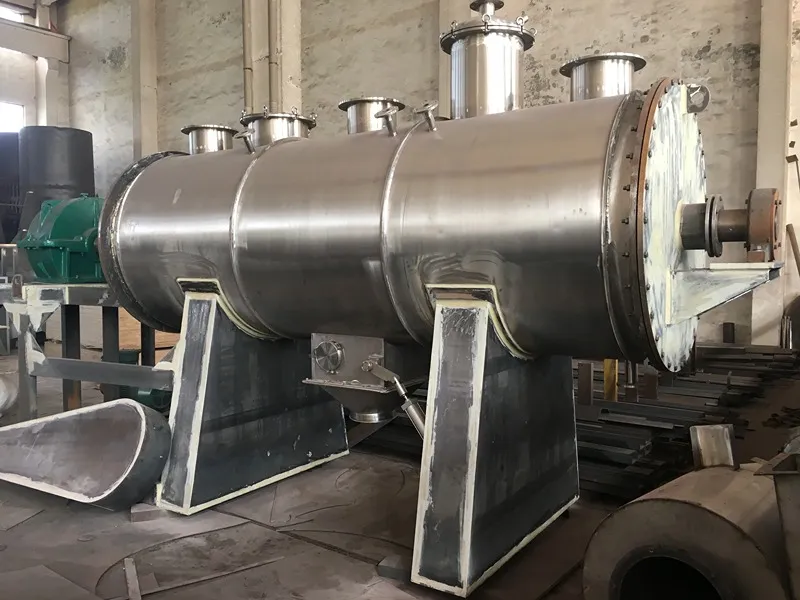
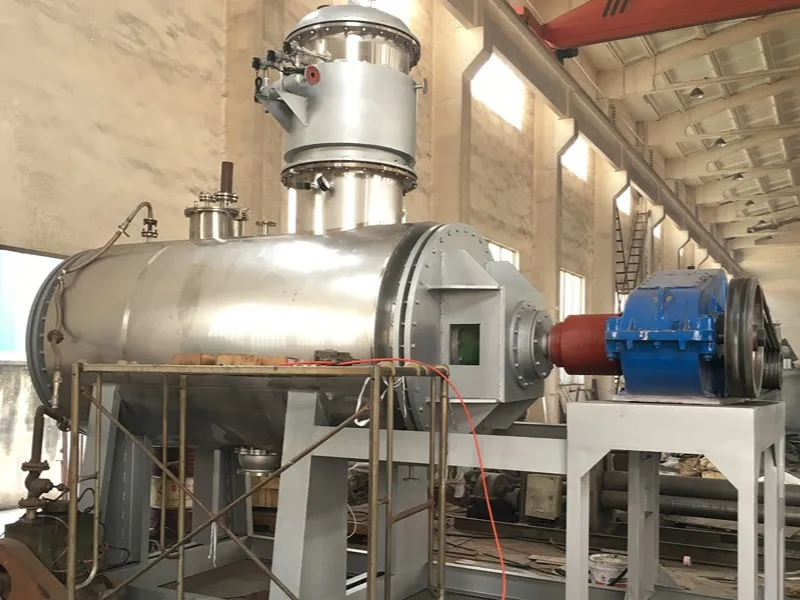
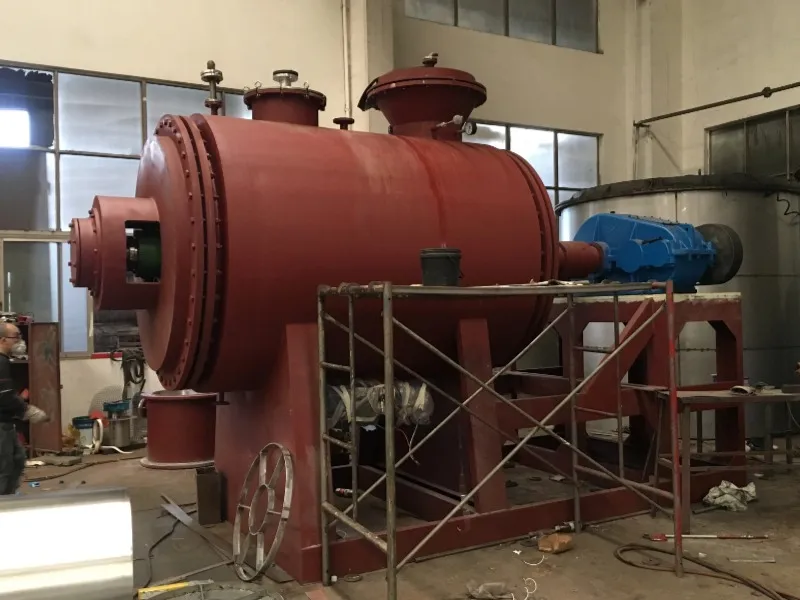
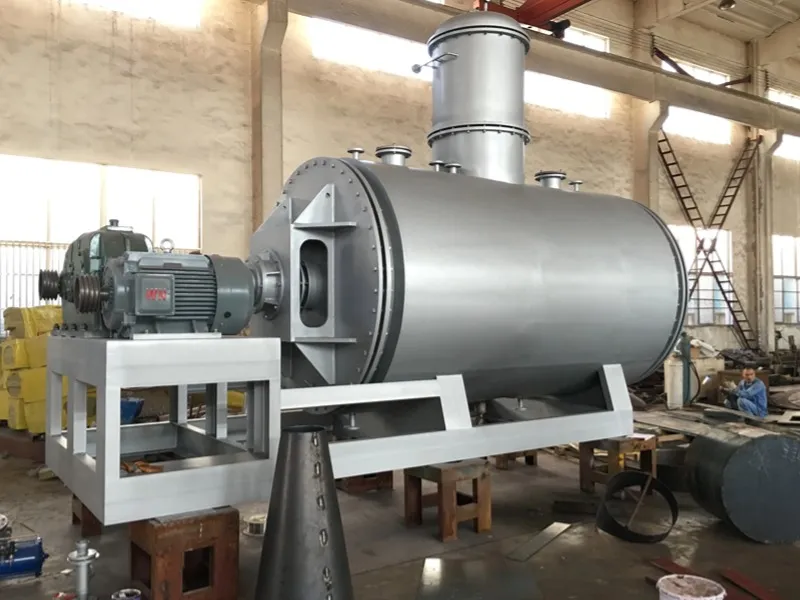
Horizontal Paddle Vacuum Dryer — Equipment Overview
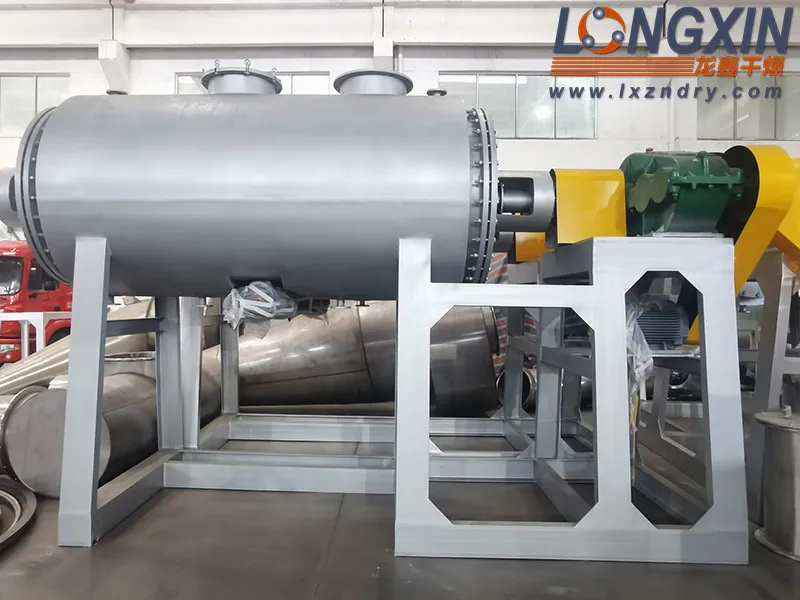
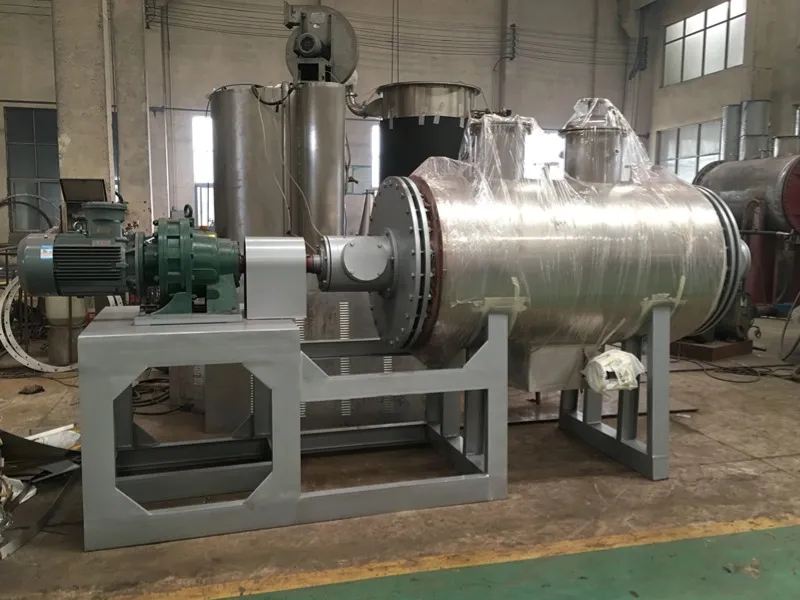
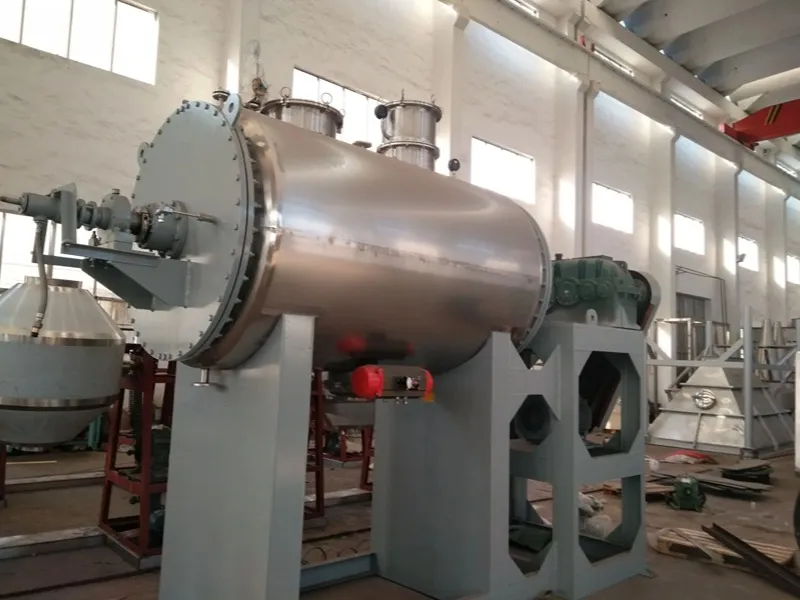
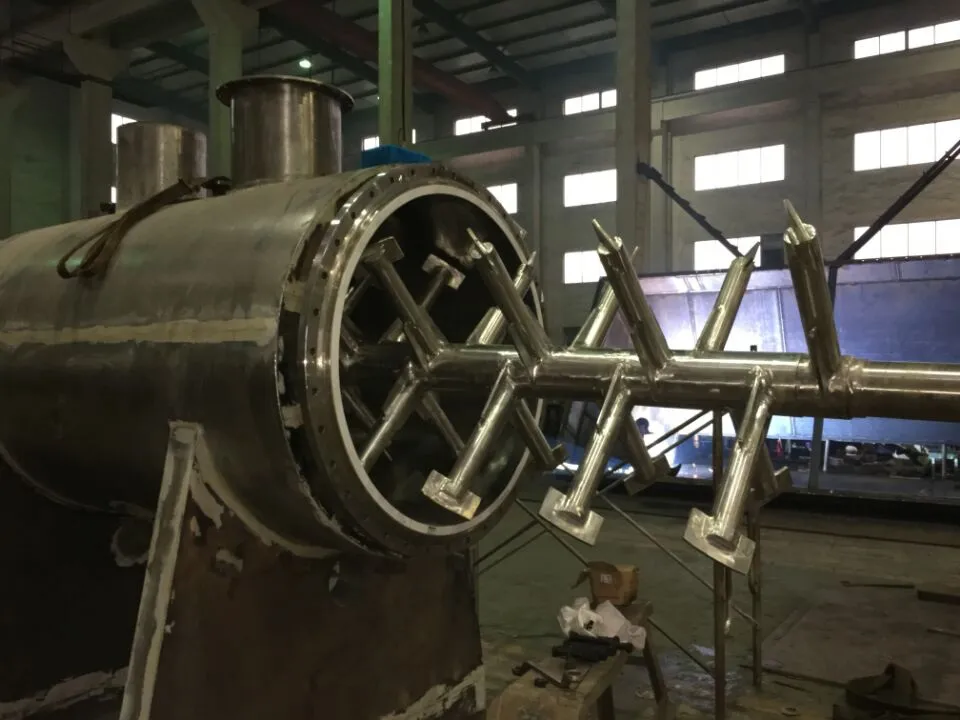
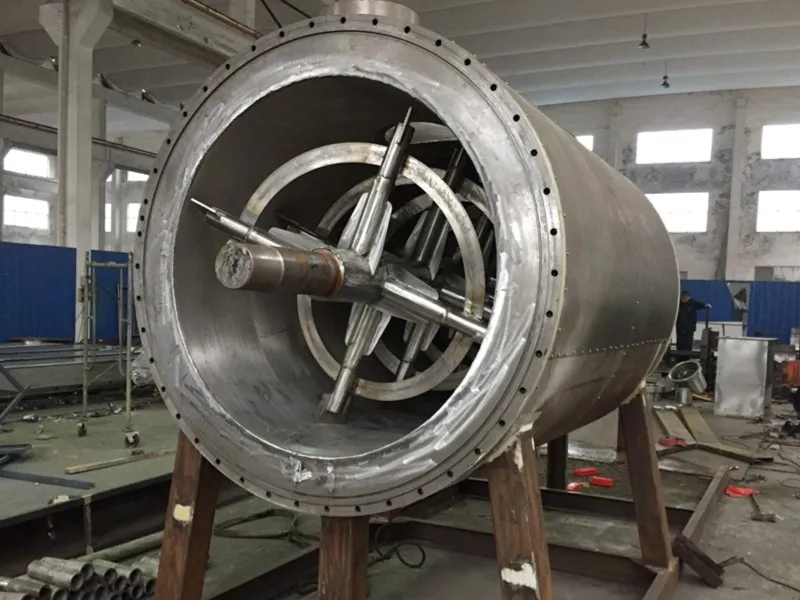
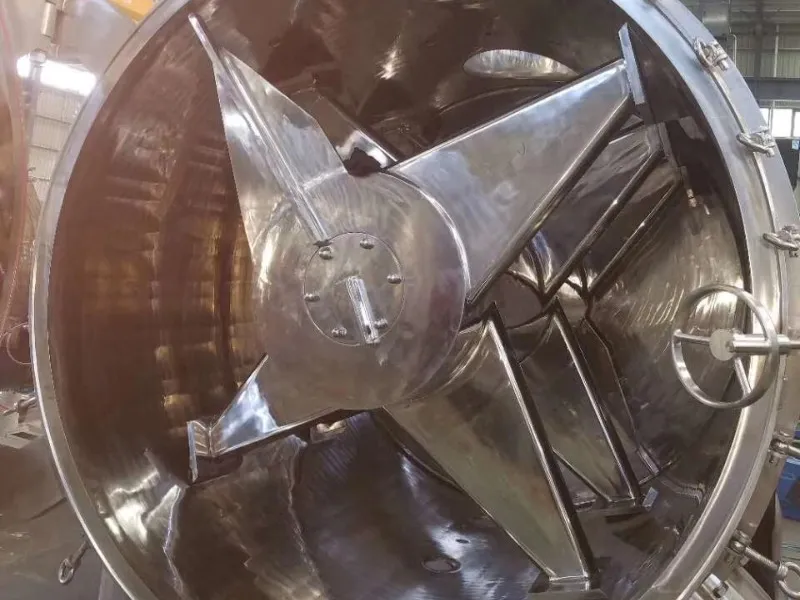
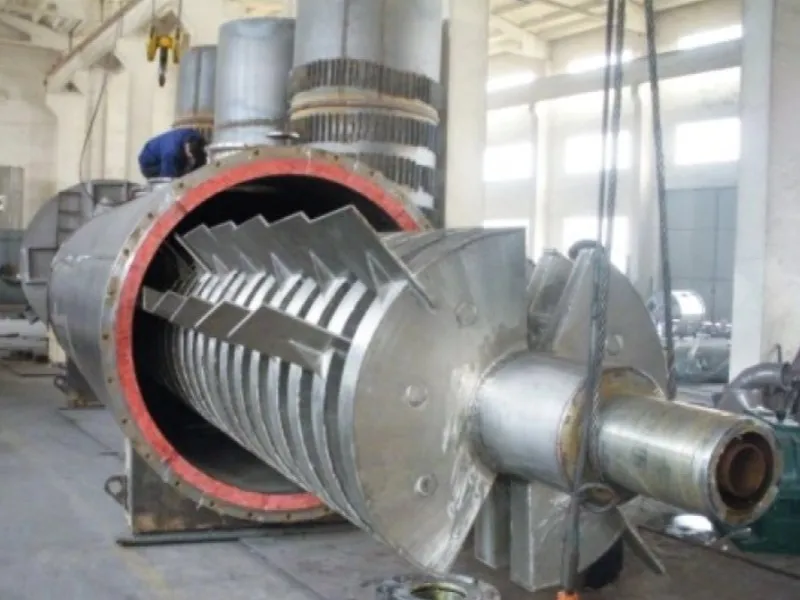
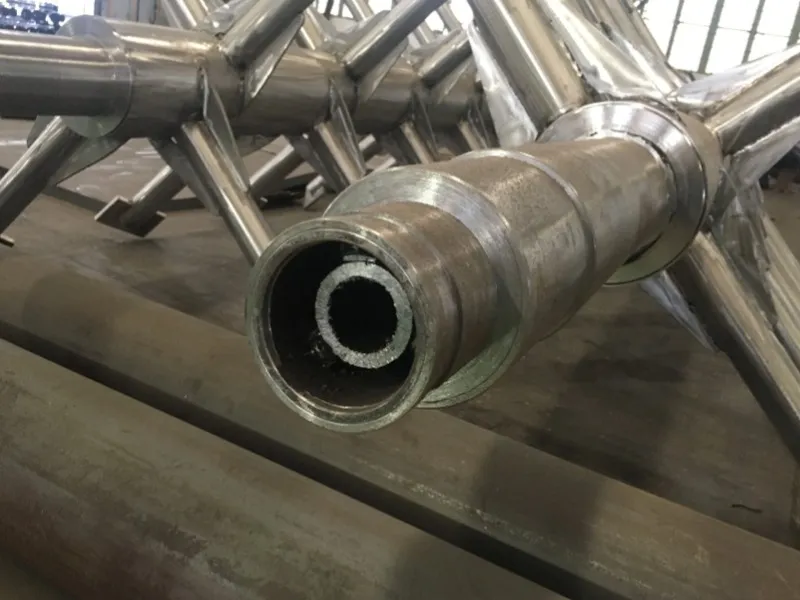
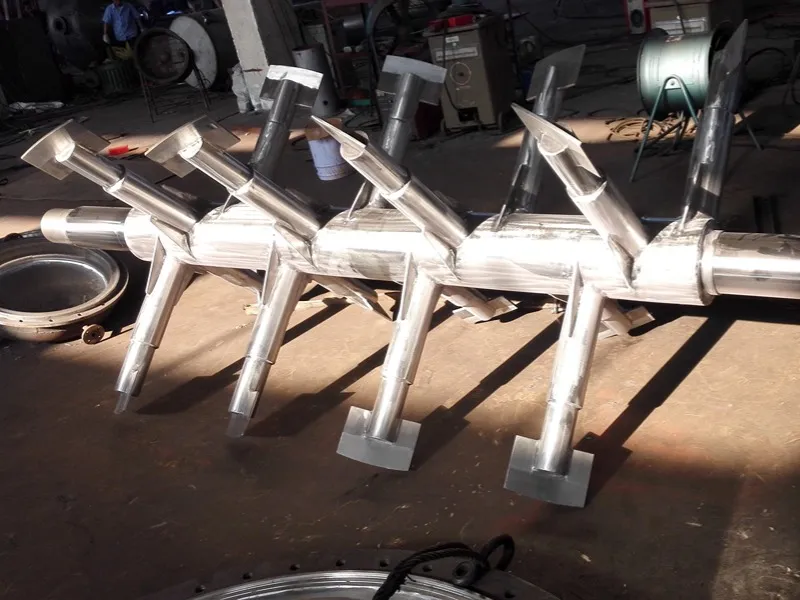
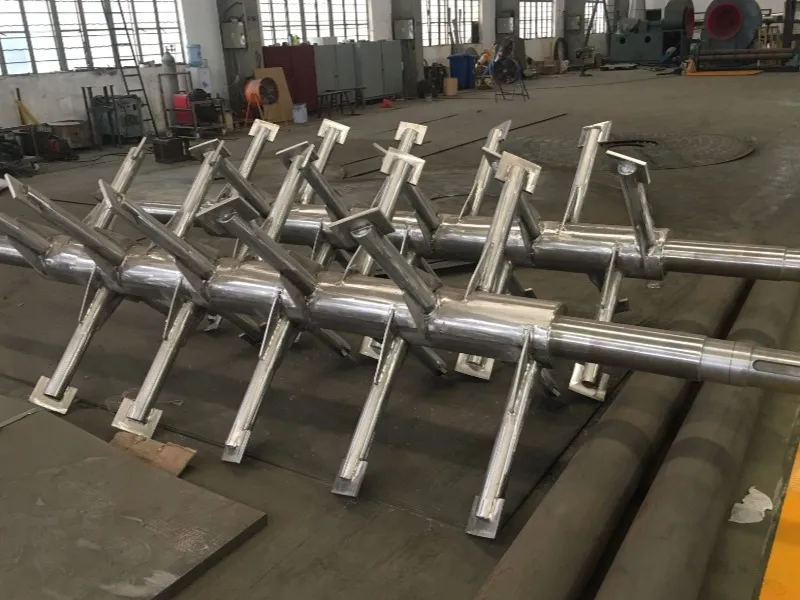
The horizontal paddle vacuum dryer is a horizontal agitated dryer that relies mainly on indirect heating by heat conduction. The blades of the horizontal paddle agitator inside the dryer are made of cast steel or thick-walled seamless tube and are mounted on a circular main shaft, with half of the blades facing left and the other half facing right. The shaft rotates at 7–8 r/min and is driven by a geared motor; automatic reversing is also provided, so that the direction of rotation of the agitator is changed every 5–8 minutes.
The horizontal paddle vacuum dryer is mainly used for drying explosive, easily oxidized and paste-like materials. It operates under high vacuum, which lowers the boiling point of the solvent and at the same time isolates air, avoiding oxidation and overheating deterioration of the material during drying.
Horizontal Paddle Vacuum Dryer — Working Principle
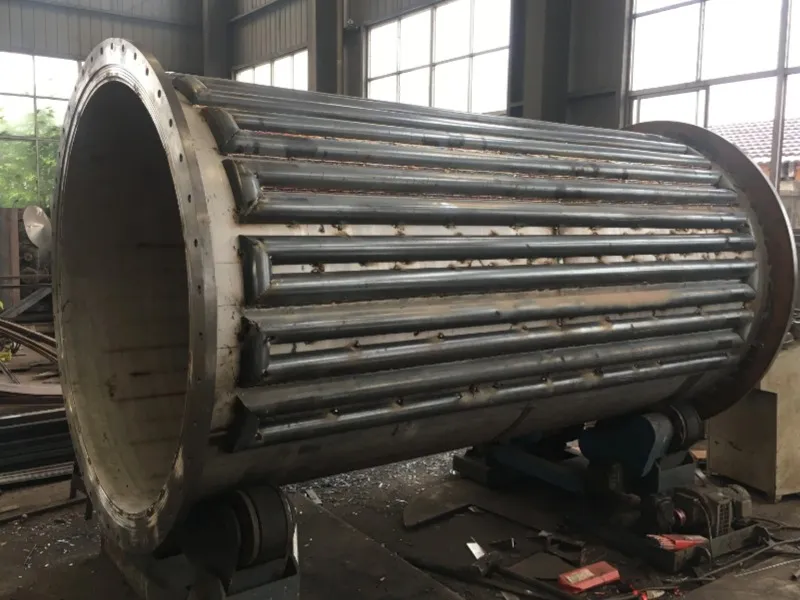
The material to be dried is fed in from the top centre of the shell. Under the agitation of the constantly rotating paddle teeth, the surface of the material is continuously renewed as it contacts the shell wall; the material is heated indirectly by steam, causing its moisture to vaporize, and the vaporized moisture is promptly drawn off by the vacuum pump. The machine can use jacket heating and paddle-tooth heating at the same time, giving a larger heat transfer area and high thermal efficiency, and thus a higher drying efficiency.
Because a relatively high vacuum is used, the water vapour pressure at the surface of the material being dried is far greater than the water vapour pressure in the evaporation space inside the dryer shell. This favours the removal of moisture from inside and from the surface of the material and the movement of water molecules within the material, achieving the drying objective.
The horizontal paddle vacuum dryer uses a steam jacket to heat the material indirectly and exhausts under high vacuum, so it is particularly suitable for materials that cannot withstand high temperatures, materials that are easily oxidized at high temperatures, materials that tend to produce dust during drying (such as various fuels), and drying operations in which the vapour or solvent removed during drying must be recovered. In the horizontal paddle vacuum dryer, the moisture or solvent content of the material to be dried can be as high as 90%, and as low as only 15%. The material to be dried may be slurry-like, paste-like, granular or powdery, and may also be fibrous.
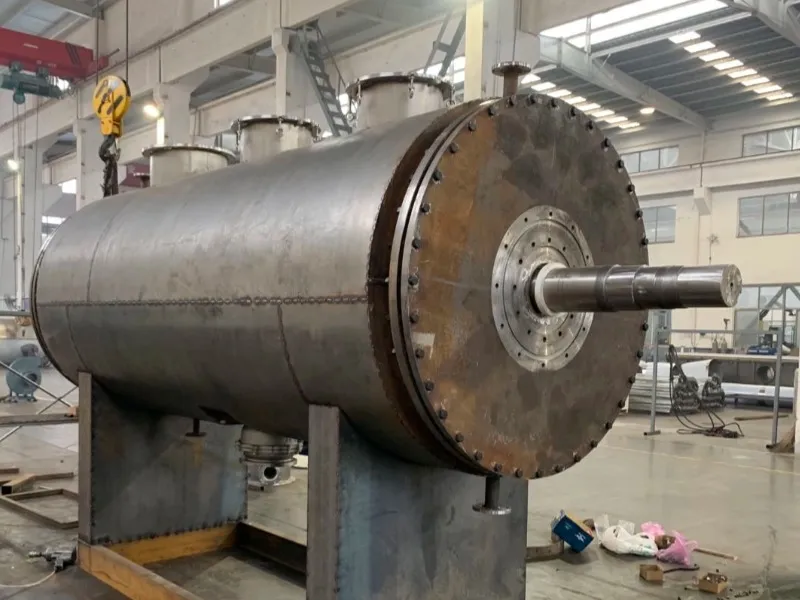
Horizontal Paddle Vacuum Dryer — Equipment Structure Diagram
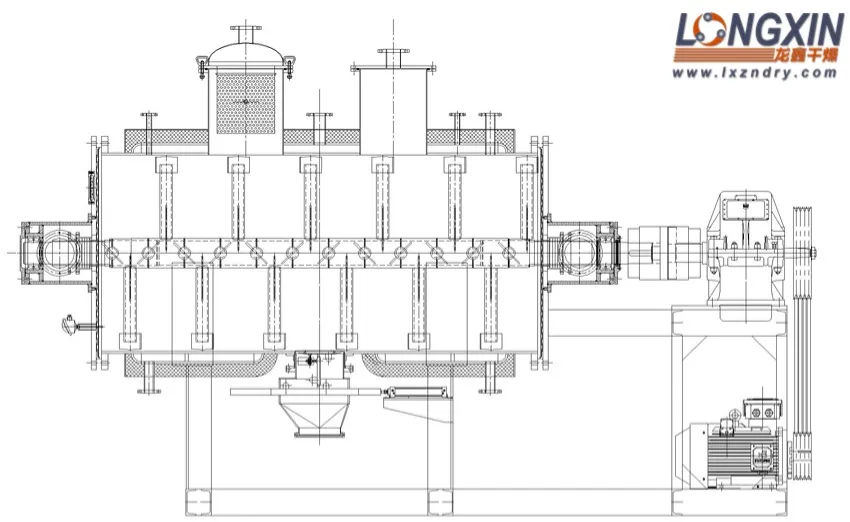
Horizontal Paddle Vacuum Dryer — Application Range
The horizontal paddle vacuum dryer is a horizontal batch vacuum drying device. The wet material evaporates by conduction; a scraper agitator continuously removes material from the heated surfaces and pushes it along inside the vessel to form a circulating flow; after evaporation the moisture is drawn off by the vacuum pump. It is suitable for drying small quantities of heat-sensitive and oxygen-sensitive muddy and paste-like materials, with a moisture content range of 15%–90%.
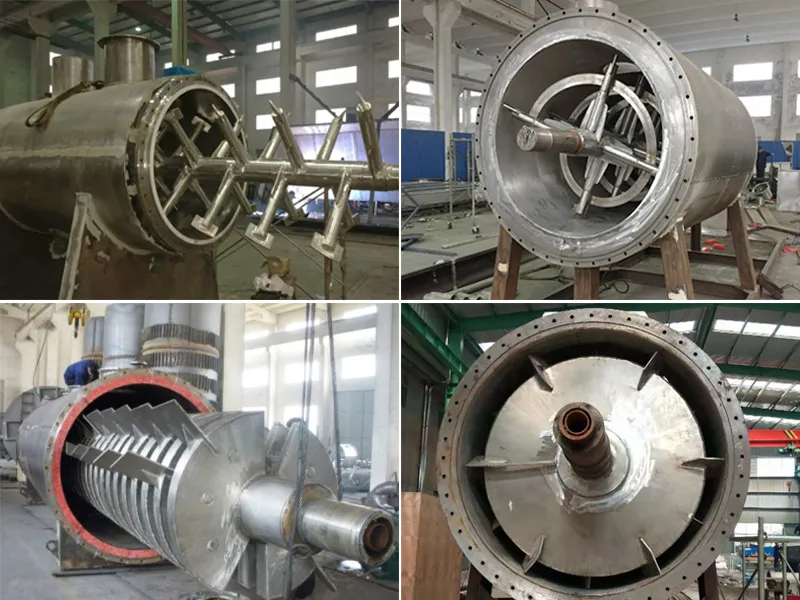
Horizontal Paddle Vacuum Dryer — Performance Features
(1) Strong adaptability and wide application: because the paddle vacuum dryer uses jacket heating and high-vacuum exhausting, it is suitable for almost all materials of different properties and states, and is particularly suitable for drying explosive, easily oxidized and paste-like materials;
(2) Low steam consumption: because the paddle vacuum dryer mostly passes steam into the jacket and uses latent heat to heat the material, the steam consumption per kilogram of finished product is relatively small — generally, evaporating 1 kg of water requires 1.3–1.8 kg of steam;
(3) Easy to operate: the paddle vacuum dryer is convenient to operate, requires few operators and involves low labour intensity. Material escape losses are reduced and the working environment is improved.
(4) Good product quality: because the paddle teeth continuously rotate forwards and backwards during drying, the material is agitated evenly, avoiding overheating of the material, and moisture escapes easily, giving a product with a low temperature and extremely low moisture content. Because the product is fine in particle size, it can be packed without further crushing;
(5) No air is introduced, the condenser load is very small, and the solvent in the material can be recovered conveniently;
(6) According to the different characteristics and requirements of the material to be dried, the sealing system of the dryer can be either a packing seal or a mechanical seal; the special design guarantees sealing performance and service life;
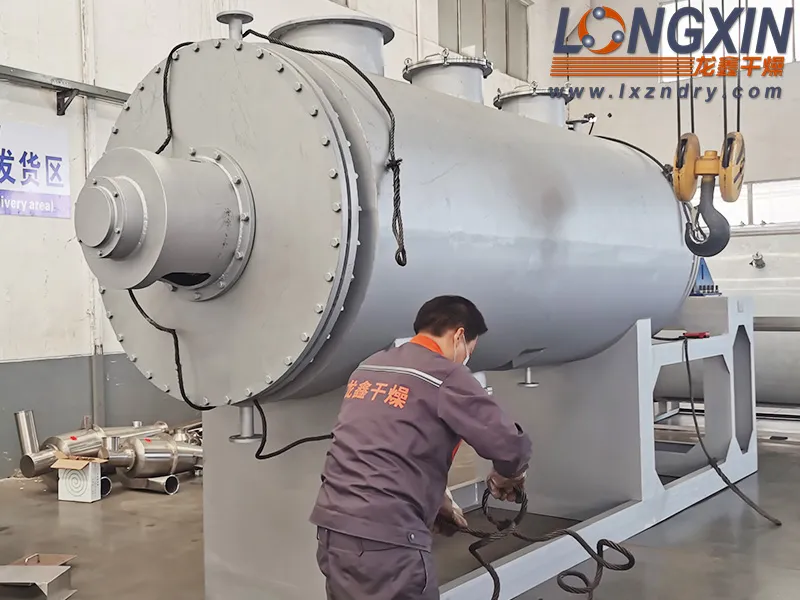
Horizontal Paddle Vacuum Dryer — Technical Improvements
The horizontal paddle vacuum dryer is a standard product of Longxin Drying and has been developed into a series of products. During long-term manufacturing and commissioning, some problems in paddle dryers that urgently needed improvement were identified: because the design of the fluid flow channel structure was unreasonable, drying efficiency was relatively low, which directly restricted the effectiveness of the equipment; the structural design was not entirely reasonable, making it difficult to meet the requirements of large-scale units; and there was still a certain gap in technical level compared with foreign products, so special types of paddle vacuum dryers still had to be imported from abroad.
In recent years, as the chemical industry has developed rapidly and grown ever larger, higher demands have been placed on the production capacity of drying systems. In response to the development of the new industry, Jiangsu Longxin has developed and brought into being four types of paddle vacuum dryers: the paddle vacuum dryer, the paddle knocker-rod vacuum dryer, the blade paddle vacuum dryer and the double-ribbon paddle vacuum dryer. Among these, the blade paddle vacuum dryer is a model produced by adaptively improving an ordinary paddle vacuum dryer on the basis of a paddle dryer, and it features a large heat transfer area and a fast drying rate.